

Pet-Safe Algae Control for Fountains: A Practical Guide
Could the safest algae treatment be the one you don’t add? If your dog or cat can reach the fountain, it’s natural to be cautious about adding anything to the water. That’s why pet safe algae control for fountains starts with prevention and regular upkeep, not a quick chemical fix. Algae often returns when the conditions that support it remain, and product labels can be difficult to interpret when pets may be exposed.
This guide explains how to remove visible algae through careful cleaning, reduce common conditions that encourage growth and build a manageable routine for your fountain. If you’re considering a treatment, check the label for its intended use, application directions and animal precautions, including whether APVMA approval applies. A practical check of circulation, debris and visible growth can help you choose a suitable next step without assuming that clear-looking water is safe for pets.
Key Takeaways
- Start pet safe algae control for fountains with physical cleaning and prevention. Consider a treatment only when its directions cover your fountain and household.
- Read the full label for intended use, application directions, animal precautions and access instructions. A general “pet-safe” claim doesn’t necessarily mean pets can drink treated water.
- Brush and rinse algae away carefully, following the fountain maker’s guidance to avoid damaging the pump or other components.
- Make checks part of your routine: look for debris and visible growth, then clean and refill as appropriate for your fountain.
- Built-in filtration can be a useful fountain feature, but routine upkeep still matters. The Bakyard Cascara Solar-Powered Water Fountain has built-in filtration and a 5-litre capacity.
Why algae grows in fountains, and what pet owners should consider first
Green film, slippery surfaces or cloudy water can be signs of algae growing in a garden fountain. Algae is a broad term for simple organisms that can develop in still or circulating water. A pump keeps water moving, but movement alone doesn’t prevent growth. Light, warmth, water conditions and organic material can all play a part, and the combination varies between fountains.
That’s why pet safe algae control for fountains starts with looking at the fountain and its surroundings, rather than choosing a treatment by name alone. Managing algae can improve a fountain’s appearance, but it doesn’t establish that the water is safe for animals to drink. Clear-looking water isn’t a reliable safety check either. For a general overview of types of algaecides and their mechanisms, see Wikipedia, then use the specific product label to guide any treatment decision.
What can encourage algae in a garden fountain?
Design and maintenance matter, too. Water movement, shaded or sheltered areas, and how easily you can reach the basin and pump can affect where growth appears and how quickly you notice it. Look for patterns: a sunny patch that turns green first, or debris gathering around the pump, can show where cleaning needs extra attention. Note where growth starts and whether it returns in the same place after cleaning.
Why pet access changes the algae-control decision
Dogs and cats may drink from fountain water or splash in it, so choosing a treatment means considering how an animal could be exposed. Wording such as “natural” or “pet-friendly” doesn’t explain every condition of use. Check whether the product is intended for ornamental fountains, which animals the label discusses, and what precautions it gives.
Keep pets away while you clean or apply a treatment. Follow the label’s directions, including any instructions about when animals can return. A statement that a product is suitable around pets doesn’t necessarily mean the treated water is intended for drinking.
Before taking action, note whether growth is on the basin, around the waterline or near the pump, and whether leaves or other debris are collecting nearby. This quick check helps you choose a proportionate next step: remove visible material, review your upkeep routine or assess a treatment label. If your fountain has maker instructions for cleaning, follow them to protect its surfaces and components. A cautious approach keeps pet exposure in view without assuming every fountain, product or algae problem is the same.
How to assess whether an algae treatment is suitable around pets
A treatment’s name or front-label claim can’t tell you everything you need to know. For pet safe algae control for fountains, read the full label before use and make sure it addresses both the fountain and the ways your pet might come into contact with the water. If either point is unclear, don’t apply the product while animals can reach the fountain.
A product’s general safety claim does not prove that fountain water is safe for pets to drink. A statement about environmental impact, plants or wildlife isn’t automatically a statement about pets drinking treated water. The Center for Pet Safety discusses the importance of clean water and biofilm prevention for pets, reinforcing why water quality and exposure deserve separate consideration.
What to look for on a fountain treatment label
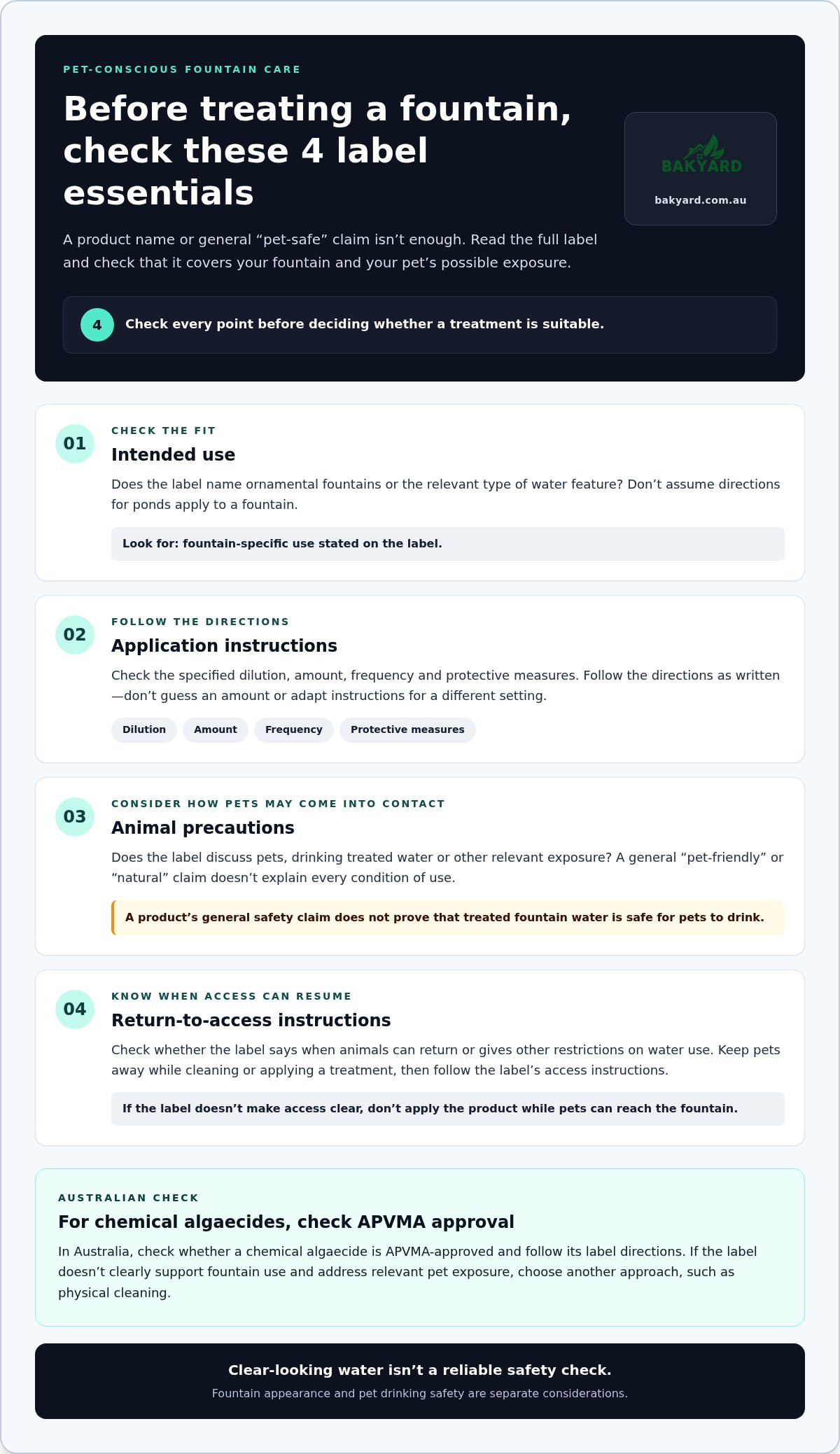
Check four essentials on the label before deciding whether a product is suitable. Look for directions that cover ornamental fountains or your specific type of water feature, rather than assuming pond directions apply. Then check how to apply it and what it says about animals and access.
- Intended use: Does the label name fountains or the relevant water feature?
- Application directions: What dilution, amount, frequency and protective measures are specified?
- Animal precautions: Does it discuss pets, drinking from treated water or other relevant exposure?
- Return to access: Does it say when animals can return, or give other restrictions on water use?
For chemical algaecides in Australia, check whether the product is APVMA-approved and follow its label directions. Don’t adapt directions for a different setting or guess at an application amount. If the label doesn’t clearly support fountain use and address relevant pet exposure, choose another approach, such as physical cleaning, rather than using it around accessible water.
Why “pet-safe” and “natural” need context
“Pet-friendly” and “natural” are broad phrases, not a substitute for instructions. They may not tell you whether the product is intended for ornamental fountains, whether treated water can be drunk or how long pets should be kept away. Read the whole label, including precautions and restrictions, rather than relying on a short claim or product name.
If directions are missing or confusing, keep pets away and don’t apply the product until you have reliable guidance. During cleaning or treatment, prevent animals from drinking or splashing in the water; restore access only as the label directs. Don’t interpret a lack of instructions as approval.
Not every algae problem needs a chemical response. Knowing what the label actually covers helps you weigh treatment against routine upkeep and choose an approach that suits your household. If you’re also considering a feature for your outdoor space, explore Bakyard water fountains with maintenance and pet access in mind.
Physical cleaning, prevention or treatment: compare fountain algae-control options
There isn’t one right response for every fountain. A light film with loose leaves nearby may call for cleaning and a closer look at upkeep. If growth keeps returning, review the fountain’s location and maintenance routine. A treatment is another option only if its label covers the water feature and relevant pet exposure. Compare the approaches before choosing.
| Approach | Effort | Pet-access considerations |
|---|---|---|
| Manual cleaning | Hands-on work to remove visible growth and debris; may include attention to the basin, pump and filter as their care instructions allow. | Keep pets away while cleaning. Restore access only when the fountain is refilled and ready for use. |
| Prevention and upkeep | Ongoing checks to remove debris and review placement, water movement and cleaning needs. | Usually avoids adding a treatment, but don’t assume fountain water is suitable for drinking. |
| Label-directed treatment | Depends on the product’s application and repeat-use directions. | Use only when the label supports the fountain use and explains relevant animal precautions and access instructions. |
When physical cleaning is the sensible first step
If you can see algae or debris, start by following the fountain maker’s care instructions. Keep pets away, then remove loose material and brush accessible surfaces without scouring them or forcing water into components. Rinse or refill as directed. Check the pump and filter only as their own instructions allow, since unsuitable handling can affect how they work.
When prevention or a labelled treatment may be considered
Before reaching for a product, look for practical changes. Clear away leaves, review how much sun reaches the basin and consider whether your checks are keeping up with visible debris. These steps can help reduce maintenance triggers, but they can’t guarantee algae won’t return. If you’re considering treatment, its label must specifically support the fountain type and address relevant pet exposure.
Use the table as a starting point, not a promise that one method will suit every setup. For pet safe algae control for fountains, match the approach to the amount and location of growth, the fountain maker’s instructions and whether pets can reach the water. If choosing a chemical product in Australia, check its APVMA status where applicable and follow its full label, including application and animal-access directions. If those directions don’t cover your situation, don’t improvise. Stick with supported physical upkeep while you seek reliable product guidance.
How to build a pet-conscious fountain cleaning routine
A repeatable routine makes fountain upkeep easier to fit around everyday backyard life. Rather than setting the same cleaning interval for every feature, use visible growth, debris and the maker’s care instructions to decide when to check and clean. Keeping a short record can also help you spot whether leaves, a sunny position or another recurring condition is linked to algae returning.
A simple clean-and-check sequence
Before starting, keep pets away and switch off the fountain as its instructions direct. Work through the steps in order, adapting them to the fountain’s materials and design:
- Inspect the fountain. Look for visible growth, leaves, dust and other debris in the basin and around the waterline.
- Remove loose material. Clear debris by hand or with a suitable tool, taking care not to push it into the pump or other components.
- Clean accessible surfaces. Brush affected areas using the method recommended by the fountain maker. Don’t use household chemicals or cleaning products unless the care instructions allow them.
- Rinse or refill as directed. Follow the fountain’s guidance for rinsing and replacing water, rather than assuming the same method suits every feature.
- Check operation. Restart the fountain only as instructed and make sure it’s running as intended before pets can approach it again.
Give the pump and filter attention only according to their own care guidance. Designs differ, and dismantling or cleaning components in an unsuitable way could affect how the fountain operates. Keep pets away throughout the job and until the fountain is ready for use.
Adjust upkeep to the fountain and backyard
Let what you observe guide your next check. If leaves collect quickly or visible growth appears soon after cleaning, inspect the feature more often for a while and note what’s changed. Nearby plants may add fallen material, while strong sun can influence how quickly growth becomes noticeable. Where practical, review whether the fountain’s placement or surrounding debris is adding to the upkeep.
Don’t rely on a fixed schedule that ignores the fountain’s conditions. Follow the maker’s directions for the pump, filter and basin, and any product label if you use a treatment. This keeps your pet-conscious routine specific to the feature instead of applying advice intended for a different design.
A simple log can reveal useful patterns. Note the cleaning date, what you found, where growth appeared and whether debris had built up. If the same spot repeatedly needs attention, adjust your checks or review that area’s exposure and surroundings. This practical record supports pet safe algae control for fountains without assuming algae can be prevented from returning.
If you’re choosing a feature for your outdoor space, explore Bakyard water fountains for your backyard and plan upkeep around the fountain’s care instructions and your pets’ access.
Choosing and maintaining a fountain for a pet-friendly backyard
A fountain can bring movement and a calming touch to a backyard, but upkeep is part of choosing the right feature. Think about where pets can reach, how easily you can clean the basin and what the maker recommends for ongoing care. A built-in filter can support the fountain’s operation, but it doesn’t remove the need to inspect and clean the feature or establish that its water is safe for pets to drink.
Which fountain features can make routine care easier?
Before choosing a design, consider the practical jobs you’ll need to do. Accessible surfaces can be simpler to brush, and removable parts may make some cleaning tasks more straightforward if the fountain’s instructions support their removal. Look for clear guidance on filter and pump care so you know how to maintain those components without guessing.
Filtration is a useful feature to consider, but it isn’t a guarantee against algae. Sunlight, debris and upkeep still affect a water feature, so plan for regular checks that suit your backyard. For pet safe algae control for fountains, choose a feature you can maintain properly while managing how pets access the water.
What the Cascara fountain offers, and what it does not promise
The Bakyard Cascara Solar-Powered Water Fountain is a solar-powered option with built-in filtration, a silent solar electric pump and a 5-litre water capacity. These product details are worth considering when choosing a fountain for your space. They don’t mean the fountain prevents algae, replaces routine cleaning or makes its water safe for animals to drink.
Whatever design you choose, read its care instructions before cleaning or handling the pump and filter. Keep pets away during maintenance, and don’t assume a feature such as filtration changes the precautions needed around accessible water. A manageable routine and a fountain that suits the space go hand in hand.
Think about where the fountain will sit, how much debris nearby plants may drop into it, and whether you’ll be able to reach the surfaces that need cleaning. Also consider how you’ll supervise pet access, particularly while the fountain is being maintained. These everyday details can matter as much as appearance when deciding what will work well in your backyard.
If you’re ready to find a feature that fits your outdoor space, explore the Bakyard water fountain range and choose a fountain that suits your backyard and the upkeep you can manage.
Make your next fountain choice with confidence
A pet-conscious backyard doesn’t need a complicated maintenance plan. Choose a fountain that suits your space and the care you can realistically keep up with, then keep pets’ access in mind whenever you clean or consider a treatment. That practical approach is the foundation of pet safe algae control for fountains, without relying on a product claim to answer every safety question.
If you’re weighing up features, the Bakyard Cascara Solar-Powered Water Fountain has built-in filtration and a 5-litre water capacity. Bakyard water fountains also come with a five-year Australian warranty. These details can inform your choice, while routine upkeep remains part of owning any water feature.
Ready to find a fountain that suits your outdoor space? Explore Bakyard water fountains for your backyard and take the next step towards a welcoming backyard you and your pets can enjoy.
Frequently Asked Questions
Is algae in a garden fountain harmful to pets?
It depends on what’s growing in the water, and appearance alone can’t identify it. Some algae, including certain blue-green algae, can be toxic, while a patch of green growth isn’t enough to confirm what type is present. Keep pets away from water that looks unusual, smells unpleasant or has a surface scum. If your pet drinks it or seems unwell, contact a veterinarian promptly.
Can I use an algae treatment in a fountain my dog drinks from?
Only consider a treatment if its label specifically supports use in that type of fountain and clearly explains whether treated water can be consumed by dogs. A general “pet-friendly” claim may not cover drinking. For pet safe algae control for fountains, keep your dog away during application and for the period stated on the label. If drinking safety isn’t clearly addressed, don’t use that product in accessible water.
How do I remove algae from a fountain without chemicals?
Switch off the fountain as its care instructions direct, then remove loose growth and debris with a suitable brush or cloth. Clean surfaces gently, taking care around the pump and other components. Follow the maker’s directions for rinsing, emptying and refilling, and clean the filter only as instructed. Avoid household cleaners unless the fountain guidance allows them. Keep pets away until cleaning is complete and the fountain is ready to run.
How often should I clean an outdoor fountain to prevent algae?
There’s no single cleaning interval that suits every fountain. Check it more often if you see growth returning quickly or leaves and other debris building up. For example, after a windy day, inspect the basin for fallen material rather than waiting for your next planned clean. Use the fountain maker’s instructions and your own observations to adjust upkeep. Regular checks can help you respond early, but can’t guarantee algae won’t return.
Does a fountain filter stop algae from growing?
No. A filter can be a useful fountain feature, but it shouldn’t be treated as an algae-prevention guarantee or a substitute for cleaning. Check the filter as the maker directs, especially if the fountain’s flow changes or debris is visible. Built-in filtration also doesn’t establish that fountain water is safe for pets to drink. Keep a separate supply of fresh drinking water available for your animals.
What should I do if my pet drinks treated fountain water?
Prevent further access and contact your veterinarian promptly for advice, even if your pet seems fine. Keep the product packaging or label handy, and note the product name, when the drinking happened and how much water may have been consumed. Don’t try to make your pet vomit or give home remedies unless a veterinary professional tells you to. If your pet shows signs of illness, seek urgent veterinary care.
Can sunlight make algae grow faster in a garden fountain?
Yes, sunlight can encourage algae because it provides light for growth. Warm conditions may also contribute, so a fountain exposed to strong sun can need closer observation than one in a more shaded spot. Check where growth first appears and whether debris collects in the same area. If practical, review the fountain’s placement, while still following its care instructions and keeping pet access in mind.