

Battery powered garden tools: compare mower, blower and trimmer performance
The most useful cordless setup may be the one that shares a battery across several tools. This battery-powered garden tools review recommends an 18V to 40V battery platform with a 4.0Ah battery for most garden tools. Choosing a compatible platform can reduce the need to buy a separate battery for every mower, blower and trimmer.
Cordless garden tools are appealing because they avoid petrol and power cords, but runtime, charging and battery end-of-life still matter. This battery powered garden tools review compares cutting and clearing performance, battery use, charging and compatibility, while weighing the sustainability trade-offs of lithium-ion tools. Use it to decide which setup suits your yard and how to get more from each battery.
Key Takeaways
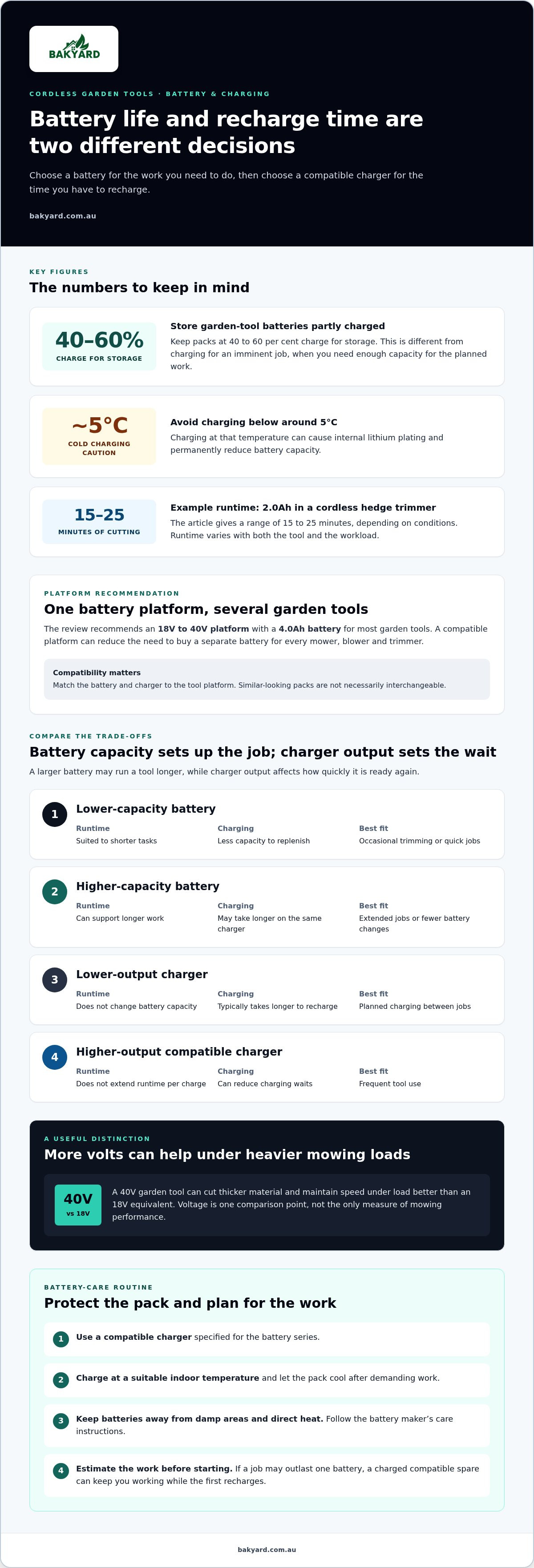
- Store batteries at 40 to 60 per cent charge, and avoid charging them below around 5°C to help protect their capacity.
- For tougher mowing, a 40V tool can maintain speed under load better than an 18V equivalent.
- Look for a brushless line trimmer if runtime matters; its motor can help a cordless tool run for up to 50 per cent longer.
- Compare mower, blower and trimmer demands before choosing a shared battery platform, as the right balance of power and runtime depends on the jobs you tackle.
- Weigh the convenience of cordless tools against battery care, compatibility and end-of-life considerations when assessing their sustainability.
Battery charging times and charger options
Runtime and recharge time are different measures. A larger battery may run a tool longer, while charger output affects how quickly it is ready again. Compare both against the work you need to complete instead of choosing by battery capacity alone.
Battery charging time
Charging time depends on battery capacity and the charger’s output, so a larger-capacity pack generally takes longer to recharge on the same charger. A compatible higher-output charger can shorten the wait compared with a lower-output option. Runtime also varies with the tool and workload: a 2.0Ah battery in a cordless hedge trimmer provides between 15 and 25 minutes of cutting, depending on conditions.
Battery storage and charging
For storage, keep garden-tool batteries at 40 to 60 per cent charge. This differs from charging for an imminent job, when you need enough capacity for the planned work. Avoid charging a battery below around 5 degrees Celsius: charging at that temperature can cause internal lithium plating and permanently reduce capacity. Store packs away from damp areas and direct heat, and follow the battery maker’s care instructions.
Battery and charger options
Battery and charger choices include different capacities, standard chargers and higher-output chargers. Capacity affects potential runtime, while charger output affects recharge time; compatibility determines whether a charger suits a particular battery series. A 2.0Ah pack can suit shorter jobs, while a higher-capacity pack can reduce interruptions during longer tasks. Match the battery and charger to the tool platform, rather than assuming similar-looking packs are interchangeable.
Use this comparison to weigh practical trade-offs before choosing a setup:
| Option | Runtime consideration | Charging consideration | Best fit |
|---|---|---|---|
| Lower-capacity battery | Suited to shorter tasks | Less capacity to replenish | Occasional trimming or quick jobs |
| Higher-capacity battery | Can support longer work | May take longer on the same charger | Extended jobs or fewer battery changes |
| Lower-output charger | Doesn’t change battery capacity | Typically takes longer to recharge | Planned charging between jobs |
| Higher-output compatible charger | Doesn’t extend runtime per charge | Can reduce charging waits | Frequent tool use |
Choose a compatible battery capacity suited to your typical jobs, then select a charger that fits your turnaround needs.
Estimate the work before you start, and have a charged spare ready if the job may outlast one battery. Dense hedge growth, for example, can slow trimming, so actual cutting time depends on the conditions and your pace. A charger cannot extend runtime on a single charge, but a second compatible battery can keep you working while the first recharges.
For a practical charging routine, charge at a suitable indoor temperature, use the charger specified for the battery series, and let the pack cool after demanding work. Plan charging around your workday, and avoid storing a pack fully depleted or charging it in cold conditions.
Battery mower cutting performance and construction
A battery lawn mower’s cutting performance depends on power under load, blade and deck design, and the grass it meets. A 40V garden tool can cut thicker material and maintain speed under load better than an 18V equivalent. In this battery powered garden tools review, voltage is one comparison point, not the only measure of mowing performance.
Compare how evenly each mower cuts, handles clippings and suits your yard. A sturdy deck can handle regular use, while a lighter build may be easier to manoeuvre around garden beds. Check the handle position, wheel movement and catcher access. Can you turn around a tree, cross uneven ground and empty the catcher without interrupting your mowing rhythm?
Match the mower to your usual grass, not just an occasional worst-case job. A regularly maintained lawn puts less demand on the blade than overgrown grass, which can slow the mower and leave an uneven finish. For a heavy first cut, make manageable passes instead of forcing the mower through dense growth. A useful battery powered garden tools review considers how well the mower handles the grass you actually have.
Trimmers call for a different comparison. Cutting width determines how much ground a line trimmer covers per pass, while line size and speed affect how it handles lawn edges and thicker growth. A wider path can cover open areas efficiently, but a narrower one offers more control around posts and garden borders. Check the maximum line size as well as ergonomics, since balance and grip affect control during repeated trimming.
For established laurel, the recommended cutting gap is at least 19mm for an 18V hedge trimmer. That helps distinguish a suitable cutter from one intended for lighter hedging. Take smaller, controlled passes through dense growth rather than pushing the blades into a thick branch. Pole saws also reward a measured approach: secure your footing, position the cutting head over the branch, then let the chain cut without forcing it.
Construction matters across all three tools, but the useful details differ. Assess deck stability and manoeuvrability on a mower, balance and cutting width on a trimmer, and reach and control on a pole saw. Note the grass condition, edge length and branches you need to tackle, then prioritise features suited to those jobs. Comparing these details gives a clearer picture than voltage alone.
Leaf blower power, noise and weight
Battery-powered tools usually make less operating noise than petrol models and avoid power cords, while corded tools can run continuously near an outlet. Battery running costs depend on charging and eventual battery replacement.
For a leaf blower, compare how it moves leaves, not just its advertised power. Air volume helps clear broad areas, while air speed can shift wet leaves or debris lodged around garden beds. A wide nozzle can sweep an open driveway efficiently; a narrower nozzle gives more control near pot plants, fences and corners. Check the blower’s balance with its battery fitted, because battery weight affects comfort during longer sessions.
Blower weight matters most when you hold the tool away from your body or work overhead. A heavier battery can make an otherwise manageable unit tiring during a long driveway clean-up. Check the grip shape, trigger reach and battery position. Variable speed helps you switch from scattered leaves on paving to debris near loose mulch without blasting the garden bed.
Noise is another practical difference between battery and petrol models. A battery leaf blower is generally quieter in use, while petrol equipment adds engine noise. Corded blowers also avoid engine noise, but their leads restrict movement and can catch around trees or outdoor furniture. Noise varies by tool and operating setting, so compare models at the speed you would actually use, not just on a low setting.
Some leaf blowers also work as vacuum-mulchers, collecting leaves and chopping them into smaller pieces. This can reduce the volume of collected material and suit a garden where leaf litter is composted. The trade-off is handling: vacuuming requires a collection bag, and damp or tangled leaves can slow the job. A blower-only model is simpler for moving leaves into a pile, especially across a large paved area.
Features can make routine blower clean-ups easier. A variable-speed trigger gives direct control, while a lock-on setting can reduce the need to hold the trigger continuously. Turbo mode may help shift stubborn debris, but higher output uses battery charge faster. On a small patio, use a lower setting and short passes; on a long driveway, plan a route that moves leaves towards one collection point.
Choose according to the job: prioritise airflow and battery capacity for a large yard, low weight and control for detailed work, and vacuum-mulching if leaf collection is part of your routine. Compare petrol, corded and battery options by noise, mobility, ongoing maintenance and task time. The best fit is the blower that clears your regular debris without making weight or cord management a chore.
Battery line trimmer performance and runtime
For Australian buyers, cordless mower, line trimmer, chainsaw and hedge-trimmer prices vary with battery capacity, motor design and included equipment. Compare the complete setup, including battery and charger, because a bare tool and a ready-to-use kit are different purchases.
A line trimmer’s runtime depends on its battery, motor and workload. For the same tool, a 4.0Ah battery lasts roughly twice as long as a 2.0Ah battery. Brushless motors can allow cordless tools to run on batteries for up to 50 per cent longer. Dense grass and frequent high-speed cutting draw more power than light edging along a maintained path.
Check maximum line size, speed and ergonomics when comparing string trimmers. A larger line can handle tougher growth, while speed control helps manage fine lawn edges without scuffing nearby plants. Balance matters too: a well-positioned battery and comfortable grip make repeated passes easier to control. Assess the tool with its battery fitted, not as a bare unit.
Hedge trimmers have a different job and cutting system. A 2.0Ah battery in a cordless hedge trimmer gives between 15 and 25 minutes of cutting, depending on conditions. That makes battery capacity and work pace important for longer hedges. Premium-brand garden-tool batteries are described as typically offering 5 to 10 years of service life with normal use.
For established laurel, choose an 18V hedge trimmer with a cutting gap of at least 19mm. Before trimming, clear loose branches from the hedge face and plan a steady path along its length. Keep the blade aligned with the surface, make controlled passes and avoid forcing it through thick growth. These techniques help maintain an even finish and limit stalls.
Battery features can make routine trimming more manageable. A brushless motor supports longer battery operation, while adjustable speed gives you more control around garden edges and delicate plants. A 4.0Ah pack can be useful for extended work, but it adds battery capacity to the tool you carry. Choose based on the hedge length, growth density and comfort during repeated movements.
Petrol trimmers suit users who value refuelling during longer jobs, while cordless models avoid petrol handling and engine noise. Their working time is limited by battery charge, so a spare compatible pack can help keep a larger job moving. Corded tools avoid battery runtime limits but restrict movement to the cable’s reach.
For a small lawn with occasional edging, prioritise a balanced trimmer and manageable battery. For longer hedges, compare cutting gap, runtime and grip comfort together. Treat line trimmers and hedge trimmers as distinct tools: their cutting systems, suitable growth and battery demands differ. Matching each tool to its actual task is more useful than choosing by voltage alone.
Interchangeable batteries across gardening and DIY tools
In Australia in 2026, the best cordless setup depends on your jobs, battery platform and tool compatibility. For most garden tools, the guide recommends an 18V to 40V platform with a 4.0Ah battery; no single brand or tool suits every yard.
For small gardens, prioritise manageable tools and a shared battery; large blocks and heavy-duty work call for more runtime and power. For mowers, chainsaws and other tools, follow each manual, wear suitable protective equipment and remove the battery before clearing a jam. Compare Australian warranty terms for the tool and battery separately.
Interchangeable battery platforms
An interchangeable platform lets compatible garden and DIY tools use batteries from the same series. That can mean one battery works across a line trimmer and drill, while another brand’s pack won’t fit, even if its voltage looks similar. Check the exact platform and tool compatibility before building a collection. A 4.0Ah battery can last roughly twice as long as a 2.0Ah battery in the same tool.
Leading battery garden tool brands
Ryobi, Makita, STIHL, EGO and DeWalt each offer battery-powered tools, but their platforms and compatible tool ranges differ. Compare the specific mower, trimmer or DIY tool you need, then assess whether its battery series covers your other planned jobs. Rather than choosing by brand name alone, weigh tool performance, battery capacity and compatibility across your shortlist.
Battery compatibility and warranty terms
Before buying, match the battery model and voltage to the tool’s stated platform. Do not assume packs interchange between brands or series. Read the warranty terms for the tool and battery, including the stated period and conditions. Bakyard Australia’s products come with a one-year Australian warranty, a concrete term to compare when considering a cordless tool purchase.
For sustainability, a shared platform can reduce the number of separate batteries needed across compatible tools. Battery longevity still depends on care and use; premium-brand garden-tool batteries are described as typically offering 5 to 10 years of service life with normal use. Keep batteries within the same platform where possible, and store them at 40 to 60 per cent charge between jobs.
Make a shortlist by yard size, workload and tools you’ll use regularly. A compact garden may need a trimmer and blower, while a large block may also need a mower and chainsaw. Check the battery series against every tool on that list before choosing a platform. For a pruning task, compare a cordless chainsaw option with the cutting jobs you expect to tackle.
Bakyard Australia: Bakyard Omnipit - 2 in 1 Fire Pit & BBQ
Bakyard Omnipit - 2 in 1 Fire Pit & BBQ brings both fire-pit and BBQ use to your outdoor living space. Once you’ve chosen garden tools for the practical jobs, this offers a different way to enjoy the backyard after the mowing and trimming are done.
If you’re shaping a relaxed outdoor area, Bakyard Australia also offers the Bakyard FireFlex - 2 in 1 Fire Pit & BBQ, Bakyard Ember Ring - 2 in 1 Fire Pit & BBQ and Bakyard Cascara Solar-Powered Water Fountain. These are outdoor living options, not substitutes for a mower, blower or trimmer. For a closer look at the Bakyard Omnipit, visit bakyard.com.au.
Make room for more backyard moments
Garden tools shape how you care for your yard, but your outdoor space can also be somewhere to pause and enjoy the result. Use this battery powered garden tools review as a starting point, then consider what would make your backyard more inviting once the work is done.
Bakyard Australia’s outdoor living range includes the Bakyard Omnipit - 2 in 1 Fire Pit & BBQ, Bakyard FireFlex - 2 in 1 Fire Pit & BBQ and Bakyard Ember Ring - 2 in 1 Fire Pit & BBQ. Each offers a different way to bring fire-pit and BBQ use into backyard gatherings. Choose the option that feels right for the way you’d like to spend time outdoors.
For a friendly next step, contact Bakyard Australia to explore the range. A well-loved backyard can be practical and welcoming, with room for everyday jobs and relaxed evenings alike. Enjoy creating a space that feels like yours.
Frequently Asked Questions
How sustainable are lithium-ion powered cordless tools?
Battery-powered tools can reduce reliance on petrol during use, but their sustainability depends on the battery’s whole lifecycle. Mining and manufacturing require resources, and worn-out batteries need responsible handling rather than household rubbish disposal. A shared battery platform can reduce the number of packs you buy, while battery care may extend their useful life. Consider how often you will use each tool and what happens to its battery at end of life.
Does a battery mower cut grass as well as a fuel-based mower?
Yes, a battery mower can produce a comparable lawn finish when its cutting system has enough power for the grass and you use an appropriate pace. Long, damp or dense grass places greater demands on any mower. For a neglected lawn, raise the cutting height first and make a second pass if needed. Petrol models can suit extended heavy work, while cordless models avoid fuel handling and are easier to start.
How does a battery mower handle?
A battery mower handles much like a push mower, but its balance depends on battery position, deck and wheel design. On a narrow path, check that it turns easily without lifting or dragging its front end. A full catcher can also change how it feels. Try a short pass around garden borders and obstacles to assess steering, grip and how comfortably you can maintain a straight line.
How does a battery-powered garden tool perform?
Performance depends on matching the tool to the task. A mower cuts grass, a blower moves leaves and a line trimmer tidies edges; each draws power differently. Check whether the tool maintains a steady pace under load, feels balanced during repeated movements and suits the material you are tackling. Clearing dry leaves across paving, for example, asks less of a blower than shifting wet, compacted debris from lawn edges.
How much runtime will I get from a battery-powered tool?
Runtime varies with battery capacity, tool type, material and how continuously you work. A trimmer edging short lawn sections uses power differently from one cutting through dense growth. High-output settings and repeated heavy cutting can shorten the time between charges. Estimate your usual job, then consider whether one battery covers it comfortably or a compatible spare would help you finish without a long interruption.
How quickly can batteries be recharged?
Recharge time depends on battery capacity and charger output. A higher-capacity pack generally takes longer on the same charger, while a compatible higher-output charger can reduce waiting. Check that the charger suits the battery series, then plan charging around your jobs. For example, use one compatible battery while another charges, rather than leaving the tool idle midway through a larger task.
Is a battery-powered garden tool well made?
Build quality varies by model, so inspect the parts that take regular strain. Check handle joints, trigger movement, battery fit, guards and adjustment points for a secure, even feel. On a mower, look for stable wheels and a deck that does not flex easily; on a trimmer, assess the shaft and head connections. A balanced tool with accessible controls is easier to use consistently during routine jobs.
What do voltage (V), amp-hour (Ah) and brushless motors mean?
Voltage (V) describes the battery platform’s electrical pressure and helps identify compatible tools. Amp-hours (Ah) describe battery capacity, which affects potential runtime rather than directly measuring cutting power. A brushless motor uses electronic control instead of brushes that make contact inside the motor. This design can improve efficiency; in cordless garden tools, brushless motors can allow batteries to run for up to 50 per cent longer.