

Solar Water Fountain Australia: Myth vs Reality for Your Backyard
What if that "bargain" solar pump you bought online isn't actually broken, but simply wasn't built for Australia's scorching summers or our intense heatwaves? It's a common story for many Aussie homeowners. You dream of a peaceful garden retreat, but you're tired of "cheap" imports that fail after a single month of service. Finding a reliable solar water fountain australia locals can actually trust feels like a gamble when you're worried about harsh UV rays damaging the product or the water stopping the moment a cloud appears.
We understand that frustration, and we agree that your outdoor space deserves better than a silent, plastic eyesore. This guide is here to help you navigate the noise. You'll discover if solar-powered features can truly handle our rugged conditions and which myths are stopping you from enjoying a tranquil, low-maintenance garden. We're going to look at the reality of battery backups versus direct solar, how to avoid the "weak stream" trap, and exactly what it takes to get zero-cost ambience for your next outdoor entertaining session.
Key Takeaways
- Learn why modern high-efficiency photovoltaic cells mean you don't need 100% scorching sun to enjoy a peaceful water feature.
- Understand how quality submersible pumps use water as a natural coolant to survive the harshest Australian summer heat without cracking or failing.
- Discover how a modern solar water fountain australia provides powerful flow rates that rival mains-powered alternatives, all while adding zero dollars to your electricity bill.
- Save time with a simple five-minute monthly maintenance routine that keeps your fountain running smoothly and debunking the high-maintenance myth.
- Get tips on matching your fountain's form and function to your specific garden layout to ensure your new feature perfectly complements your home's architecture.
The "Direct Sun" Myth: Do Solar Water Fountains Work in the Shade?
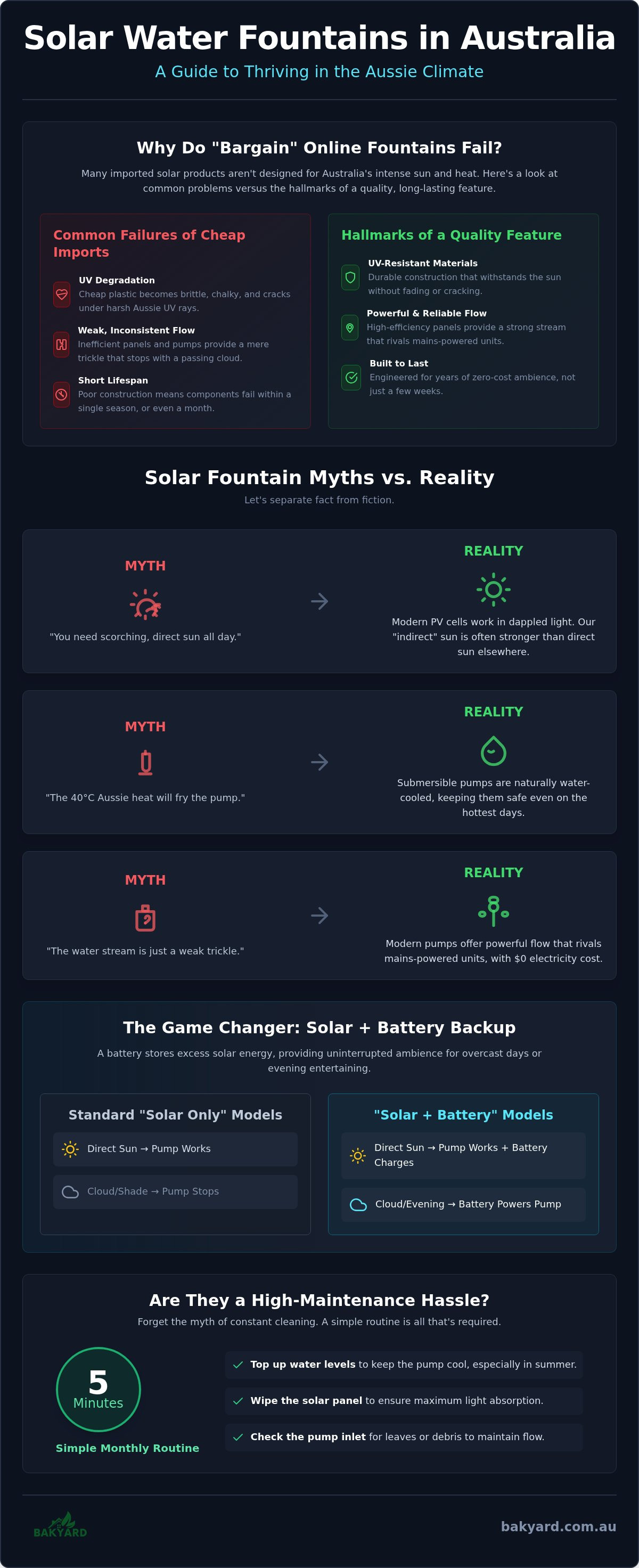
There's a common misconception that your backyard needs to look like the middle of the Simpson Desert for a water feature to function. Many Australians worry that the moment a stray cloud drifts over or the shadow of a fence creeps in, their tranquil oasis will simply stop. This is the "Direct Sun" myth, and it often stops people from even considering a solar water fountain australia homeowners would otherwise love. The reality is much brighter.
Modern high-efficiency photovoltaic (PV) cells are light-years ahead of the tech we saw a decade ago. While older models were notoriously finicky, today's components are designed to capture energy even in dappled light. Because Australia experiences some of the highest UV levels on the planet, our "indirect" light is often more powerful than the direct sunlight found in Europe or North America. This gives us a massive advantage in keeping pumps running through patchy weather.
When planning your layout, you'll generally choose between two setups:
- Integrated Panels: These sit directly on the fountain body, which is perfect for open patios, balconies, or sunny decks.
- Remote Panels: These allow you to tuck your fountain into a shady fernery or under a verandah while placing the panel up to five metres away in a sunny spot.
Understanding Photovoltaic (PV) Efficiency in the Backyard
At its heart, your solar panel is an energy factory. It captures photons from Aussie sunlight and converts them into kinetic energy to drive the motor. You can learn more about how solar-powered pumps work to see how this conversion happens without a single cent of mains electricity. Modern kits don't need a scorching 40-degree day to operate; they simply need light. By 2026 standards, high-efficiency garden PV cells can convert up to 22% of captured sunlight into usable power, ensuring a steady flow even when the sky isn't perfectly clear.
The Battery Backup Game-Changer
If you're serious about a reliable feature, the battery is your best friend. A "Solar Only" model works like a mirror; no sun, no flow. However, a "Solar + Battery" model, like the Bakyard Australia Cascara, uses Lithium-ion technology to store excess energy during the day. This stored power acts as a buffer for overcast periods or, more importantly, allows you to enjoy the soothing sound of water during an evening barbecue. In the unpredictable Aussie climate, having that stored energy is a total no-brainer for anyone looking to install a solar water fountain australia can be proud of.
Will the Aussie Heat Fry My Solar Pump?
It is a valid concern for any gardener. When the mercury hits 40 degrees in western Sydney or the Pilbara, you might worry your outdoor electronics will simply melt into a puddle. Many homeowners believe the myth that the intense Australian summer heat is a death sentence for solar components. Fortunately, the reality is far more resilient. Most high-quality solar water fountain australia kits are designed specifically to thrive in our rugged climate, provided they use the right engineering.
The secret lies in the design of the pump itself. Unlike a rooftop solar inverter that sits in a hot roof cavity, a fountain pump is submersible. This means it spends its entire working life underwater. The water acts as a natural coolant, drawing heat away from the motor even on the most scorching afternoons. As long as the basin remains full, your pump stays significantly cooler than the air around it. This built-in thermal management is what allows these features to run all day without skipping a beat.
Thermal Management in Water Features
Keeping your pump healthy during a heatwave comes down to one simple task: maintenance of water levels. If the water evaporates and the pump runs dry, it loses its cooling source and can burn out quickly. It's a good idea to check your feature every morning during summer. When positioning your solar panel, aim for that sweet spot where it gets full sun for power but isn't pressed against a heat-trapping metal fence. While you might be researching how solar panels work in the shade, remember that panels actually perform most efficiently when they have a bit of airflow behind them to stay cool.
UV Resistance: Protecting Your Investment
While heat is one factor, UV radiation is the real silent killer of garden decor. Cheap plastic fountains often fade, turn chalky, and eventually crack after just a few months of exposure. This is why investing in solar water fountain australia models made from UV-stabilised polyresin is essential. These materials are treated to resist the bleaching and structural damage caused by our thin ozone layer. At Bakyard, we focus on these durable, UV-treated finishes for our water fountains to ensure they look as good in year three as they did on day one. If a product doesn't explicitly mention UV stabilisation, it probably wasn't built for our backyard. If you're ready to add a resilient feature to your space, exploring our locally-tested range is a great place to start.
Solar vs Mains-Powered: Is the Stream Too Weak?
A common worry for those looking at a solar water fountain australia homeowners often ask about is whether the flow will be strong enough to actually hear. There's a lingering myth that solar-powered features are merely "tricklers" that struggle to push water higher than a few centimetres. While this might have been true for the flimsy plastic kits of the early 2000s, modern brushless pump technology has changed the game entirely. These pumps are remarkably efficient, providing significant lift and water volume without needing a power point.
Beyond the performance, there's the critical factor of safety. Running 240V mains power through your garden and near water carries inherent risks. Solar features operate on low-voltage DC power, usually between 6V and 18V. This makes them much safer for households with curious pets or young children. Additionally, while we've discussed how water cools the pump, it's worth checking how heat affects solar panel efficiency generally. Understanding these technical basics helps you see why a well-engineered solar kit is often the smarter choice for the Aussie backyard.
Flow Rates and Lift: What the Specs Actually Mean
When you're browsing for a feature, you'll see a rating called LPH, or Litres Per Hour. This tells you exactly how much water the pump moves. A higher LPH means a more robust splash and a better "soundscape" for your patio. The Bakyard Cascara Solar-Powered Water Fountain is specifically designed to balance high flow with energy conservation. It provides a consistent, soothing stream that can mask local traffic noise or create a focal point for outdoor entertaining. Matching the LPH to your space is key; a small courtyard needs a gentle babble, while a large open deck might benefit from a more vigorous waterfall effect.
Installation: DIY vs The Sparky
Maintenance Myths: Are They High-Maintenance Hassles?
Many people hesitate to buy a solar water fountain australia because they imagine spending every weekend scrubbing slime or polishing glass. It's an understandable worry. We've all seen garden gear that looks great for a week and then becomes a chore. However, the reality is far more relaxed. A quality solar setup is largely self-sufficient, requiring only a fraction of the effort needed for a traditional mains-powered pond or a complex pool system.
Dealing with the Aussie "Dust Bowl" is perhaps the most unique challenge we face. Red dust from the interior, salt spray near the coast, or local pollen can settle on your solar panel. This creates a thin film that acts like a tiny shade cloth, reducing your pump's efficiency. A quick wipe with a damp cloth is usually all it takes to restore full power. Ironically, your fountain actually works to keep itself clean. The constant movement of water through aeration prevents the stagnation that algae loves, meaning you'll spend less time dealing with green pond scum than you would with a still-water feature.
The 5-Minute Monthly Service
Keeping your feature in top shape doesn't require a toolkit or a degree in engineering. A simple monthly check-up ensures everything runs smoothly. Follow these three easy steps:
- Gently wipe the solar panel to remove dust, salt, or bird droppings that block the sun.
- Check the pump filter for stray leaves or garden debris that might restrict the flow.
- Top up the water level to ensure the pump stays submerged and cool, as we discussed in the thermal management section.
A clean panel is the secret to a 24/7 fountain that never loses its puff.
Wintering Your Fountain in Australia
In many parts of the world, you have to pack everything away before the first frost. In most of Australia, our winters are mild enough that your fountain can stay right where it is. If you live in the alpine regions or parts of Tasmania where water might freeze solid, it's best to bring the pump inside to prevent ice damage. For everyone else, the main task is simply managing water levels during the dry winter months to protect the pump from running dry.
You can find more detailed tips on protecting your garden gear in our guide on How to Winterise Your Backyard Fire Pit and Water Feature. Maintaining a solar water fountain australia really is as easy as it sounds. If you're ready to add that tranquil atmosphere to your deck without the hard yakka, check out our range of durable solar features today and start your garden transformation.
Choosing Your Perfect Feature: Form Meets Function
Choosing the right solar water fountain australia homeowners love involves more than just picking a pretty design. It's about understanding the unique layout of your outdoor space. A common myth is that any fountain will work anywhere, but the scale and style of your home's architecture should lead the way. Whether you're aiming for a sleek, contemporary look or a more traditional garden feel, your choice should enhance the existing vibe of your backyard.
For those with a minimalist aesthetic, the Zen Sphere Water Fountain is often the ultimate choice. Its clean lines and gentle water flow provide a sophisticated focal point without cluttering the visual landscape. It's the perfect example of how form meets function, offering a peaceful atmosphere that complements modern Australian homes. Matching your feature to your home's style ensures that your garden feels like a natural extension of your living room.
Sizing Your Fountain for the Space
Think about the scale of your area before you commit. A large, multi-tiered feature might overwhelm a small apartment balcony, while a compact tabletop fountain could easily get lost in a sprawling suburban garden. Consider where you'll place your remote solar panel too. Having a generous cord length is vital for those shady corners we mentioned earlier, allowing you to keep the feature exactly where you want it while the panel soaks up the sun elsewhere.
You can take your relaxation to the next level by creating a dedicated "Zen Zone" in your yard. Many of our customers find that pairing their water features with outdoor fire pits creates a balanced environment of fire and water. This combination is ideal for year-round entertaining, providing warmth in winter and a cooling soundscape during the summer months. It's about creating a space where you actually want to spend your time.
Why Quality Matters: The Bakyard Promise
When you buy from a local expert, you're getting more than just a box on your doorstep. The "Bakyard Advantage" means your order is handled by our Sydney-based team and shipped directly from our local warehouse. We offer free national shipping, so you don't have to worry about hidden costs at checkout. You're supporting a business that knows exactly how tough the Aussie sun can be on outdoor gear.
The real peace of mind comes from our one-year Australian warranty. Unlike international drop-shippers who disappear the moment a pump stops working, we stand by our products right here in Sydney. You can buy with confidence, knowing you have local support if you ever need it. Transform your backyard today with a Bakyard solar fountain.
Ready to Transform Your Outdoor Oasis?
You've seen that modern solar tech doesn't need a cloudless desert sky to perform, and those worries about the Aussie sun "frying" your gear are a thing of the past. By choosing a feature built for our local UV levels, you get the tranquil sound of running water without the headache of hiring a sparky or facing high power bills. Finding the right solar water fountain australia homeowners can rely on is simply about matching quality engineering with your specific garden style.
At Bakyard, we make it easy with products designed specifically for Australian conditions. Every order comes with a 1-year Australian warranty and free shipping from our Sydney warehouse to give you total peace of mind. Our team is here to help you create a space that feels like a true escape from the daily grind.
Shop the Bakyard Solar Water Fountain Collection
It is time to stop dreaming about a peaceful garden and start enjoying one. Whether you're entertaining friends or relaxing with a cuppa, your perfect backyard retreat is just a few clicks away!
Frequently Asked Questions
Do solar water fountains work at night in Australia?
Yes, they work at night provided you choose a model with an integrated battery backup. While solar-only units stop when the sun goes down, battery-equipped features store excess energy throughout the day. This allows you to enjoy the soothing sound of water and built-in LED lighting well into the evening. It is a great way to add a tranquil atmosphere to your deck during those warm summer nights.
How long do solar water fountain pumps typically last?
A high-quality solar water fountain australia pump generally lasts up to four years with the right care. The lifespan depends heavily on keeping the pump clean and ensuring the water level never drops too low. Because these pumps are brushless, they have fewer moving parts to wear out. Regular monthly maintenance is the best way to ensure your feature remains a garden staple for years.
Can I replace the battery in my solar water fountain?
Most modern fountains allow for battery replacement. These units typically use standard rechargeable Lithium-ion cells that eventually lose their ability to hold a full charge after several years of daily use. Replacing them is usually a simple DIY task that doesn't require any technical expertise. It's a cost-effective way to refresh your fountain's performance without having to replace the entire decorative unit or the solar panel system.
Will a solar fountain work on a cloudy day in Melbourne or Sydney?
Yes, your fountain will still function on overcast days in cities like Melbourne or Sydney. Modern photovoltaic panels are designed to capture a broad spectrum of light, not just direct beams. While the water flow might be slightly less vigorous than on a blue-sky day, the pump will continue to operate. If your model has a battery, it will use stored power to maintain a consistent stream during cloudy periods.
Are solar water fountains safe for birds and pets to drink from?
Solar fountains are very safe for local wildlife and domestic pets. Because the water is constantly moving and oxygenated, it stays fresher than a stagnant birdbath. To keep it safe, avoid using harsh pool chemicals or bleach to clean the basin. A simple scrub with a soft brush and fresh water is all you need to keep the environment healthy for your feathered visitors and thirsty pets.
How do I stop algae from growing in my solar water feature?
Prevention is the best cure for algae. Try to place your fountain in a spot that gets enough sun for the panel but keeps the water basin slightly shaded to stay cool. You can also use eco-friendly, bird-safe water conditioners that prevent algae blooms without harming the environment. Changing the water every few weeks during the height of summer also helps keep the basin sparkling clean and clear.
Do I need a plumber or electrician to install a solar fountain?
You don't need any professional help to set up your feature. One of the biggest benefits of a solar water fountain australia is that it is a 100% DIY project. There is no need to dig trenches for cables or pay for a licensed electrician to install outdoor power points. You can have the entire system running in about ten minutes, making it an easy weekend project for any home gardener.
What happens if my solar fountain runs out of water?
Running out of water is the most common cause of pump failure. Without water to act as a lubricant and coolant, the internal motor can quickly overheat and seize. Many modern pumps include a sensor that shuts the unit down if the water level gets too low. However, it is still best practice to check your water levels every few days, especially during a dry Aussie summer, to protect the motor.