

Mini Chainsaw vs Pruning Saw: Which Tool Wins for Your Aussie Backyard?
Have you ever spent a Saturday morning wrestling with a stubborn gum tree branch, only to end the day with a cramped hand and a garden that still looks a bit of a mess? It is a common Aussie dilemma, choosing between the exhausting manual labour of a traditional hand saw and the intimidating roar of a petrol unit. When weighing up the benefits of a mini chainsaw vs pruning saw, many gardeners feel stuck between hand fatigue and the fear of using something too powerful for a simple backyard tidy-up.
We believe that maintaining your outdoor sanctuary should be a joy, not a chore. You deserve a tool that delivers clean cuts without damaging your trees or your wrists. In this guide, we'll help you discover whether a cordless mini chainsaw or a classic pruning saw is the right fit for your specific garden needs. We will compare power levels, safety features, and exactly which branch thickness each tool can handle. By the end, you will know how to achieve effortless pruning with a tool that is easy to store and even easier to use.
Key Takeaways
- Understand the key differences between handheld battery units and manual curved blades to pick the right tool for every branch in your garden.
- Explore why the one-handed design of a mini cordless chainsaw is a total game-changer for stability and reaching high spots without the strain.
- When comparing a mini chainsaw vs pruning saw, use the "Thumb Rule" to instantly know which tool will deliver the cleanest cut for your specific branch diameter.
- See how switching to a powered option can reduce your pruning time from minutes to seconds, leaving you more time to relax in your beautiful outdoor space.
- Learn how to assess your backyard size and your own physical comfort to choose a tool that makes gardening feel like a joy rather than a chore.
Understanding the Contenders: What is a Mini Chainsaw vs a Pruning Saw?
Choosing between a mini chainsaw vs pruning saw usually comes down to how much sweat you want to break on a Sunday morning. For years, Aussie gardeners only had two real options: a small hand saw that left your arm aching or a massive petrol unit that required a gym membership just to pull the starter cord. The "mini" revolution has taken over Australian backyards because it finally offers a middle ground. These tools are lightweight, quiet, and surprisingly gutsy for their size.
A mini chainsaw is a sub-8-inch cordless power tool designed for easy, one-handed operation. This modern portable handheld power saw has become a staple for DIYers who want to get the job done without the fuss of fuel, mixing oil, or tripping over extension cords. On the other side of the fence, the traditional pruning saw remains a manual classic. It uses a curved blade designed for pull-cutting, which is excellent for precision but requires significant physical effort and a steady hand.
You might also encounter reciprocating saws, often called "recipros", being used in the garden. While they are fantastic for pulling apart an old deck or demolition work, they can be quite jumpy when used on branches. The vibration often makes it hard to get a clean start on a branch that is already swaying in the breeze, which is why most people eventually move toward a purpose-built chain tool.
The Mechanics of the Cut
The way these tools interact with wood is completely different. A chain drive uses small, sharp teeth to rip through wood fibres at high velocity. In contrast, a manual saw blade shears through the wood using back-and-forth tension. Speed is more than just a convenience; it is essential for tree health. A fast cut prevents "bark tearing", which is when the weight of a falling branch peels a strip of bark away from the trunk. A quick zip from the Bakyard Mini Cordless Chainsaw ensures the cut is finished before the wood has a chance to splinter or peel.
Typical Use Cases in the Aussie Garden
Our backyards often face harsh conditions, from summer storms to long droughts. You might find yourself tidying up fallen gum branches or trying to organise a wild Bottlebrush that has grown out of control. Manual tools are perfect for soft, green wood, but they often meet their match when facing seasoned Australian hardwoods. If you are thinning out a thick Grevillea or clearing away debris after a heavy wind, the extra power of a battery-operated tool makes the work feel effortless. It allows you to spend less time fighting with a branch and more time enjoying your outdoor space.
The Rise of the Mini Cordless Chainsaw: Power in Your Pocket
The days of dragging a tangled 20-metre extension cord across the lawn or wrestling with a finicky petrol pull-start are finally over. Modern battery technology has completely changed how we look after our gardens. When comparing the mini chainsaw vs pruning saw, the sheer convenience of a cordless unit is hard to beat. As of 2026, lithium-ion cells have become so efficient that a single charge provides enough juice for a full afternoon of lopping and tidying. It is about having the freedom to move from the front verge to the back fence without a second thought.
One-handed operation is the real game-changer here. Traditional chainsaws are heavy and demand a two-handed grip for safety, which makes it nearly impossible to stabilise a branch with your free hand. A mini cordless unit allows you to reach into dense shrubs or overhead branches while maintaining a firm footing. It is a much more stable way to work, especially when you are trying to organise a messy corner of the yard. Maintenance is also a breeze. You don't have to worry about mixing fuel or cleaning carburettors; you just keep the chain tensioned and the battery charged.
Safety Features You Cannot Ignore
Safety is often the biggest concern for DIYers moving from manual tools to power equipment. Thankfully, these handheld units are designed with user-friendly protection in mind. The Bakyard Mini Cordless Chainsaw features essential hand guards and trigger lockouts to prevent accidental starts. Because the bar is much shorter than a standard saw, the risk of "kickback" is significantly reduced. This makes it a far less intimidating entry point for those who want power without the peril. For a deeper look at how to use these tools correctly, this guide to pruning equipment offers excellent advice for home gardeners.
Ergonomics and Reducing Garden Fatigue
We need to talk about the "fatigue factor", which is often overlooked in professional tool reviews. If you are an older gardener or someone who suffers from wrist and shoulder strain, manual sawing is a literal pain. A manual saw requires constant, repetitive motion that can quickly lead to cramping. In contrast, a mini chainsaw weighs roughly 1.2kg. It does the heavy lifting for you. What used to be five minutes of strenuous manual sawing becomes five seconds of effortless zipping. It turns a daunting weekend chore into a quick, satisfying task. If you want to make your garden maintenance feel like a joy again, you might want to check out a lightweight cordless option for your next backyard session.
Pruning Saws Explored: Manual and Reciprocating Options
While the mini chainsaw is the shiny new favourite in many Aussie sheds, the humble pruning saw hasn't disappeared just yet. When weighing up the mini chainsaw vs pruning saw, the manual version is the silent, no-battery-required classic that is always ready to go. It is perfect for those quick, delicate tasks where a power tool might feel like overkill. If you are into fruit tree grafting or need a surgical cut on a prized rose bush, the precision of a manual blade is hard to beat.
However, manual tools have their limits. Over time, blades lose their edge and become what many gardeners call "knuckle-scrapers". They stop slicing and start tearing wood fibres, which leaves your trees vulnerable to disease and pests. They also require a lot of elbow grease. If you have a large property with more than a few shrubs, relying solely on manual power is a recipe for a very sore Sunday evening. It is about finding the right balance between tradition and modern convenience.
Manual Saws: The Silent Workhorse
Most manual saws come with either a curved or straight blade. The curved design is a lifesaver because it helps you "hook" into a branch, using the pull-stroke to do most of the heavy lifting. It is a great workout, but calculating the calories burned versus using a battery-powered alternative usually makes the choice clear for most. These days, manual saws are often relegated to the emergency kit. They are kept aside for that one branch you missed after your mini cordless chainsaw battery has finally run flat.
Electric Reciprocating Saws
Then there is the electric reciprocating saw, often called the "recipro". These are demolition beasts, great for ripping out an old fence or cutting through root balls covered in dirt. Unlike a chainsaw, a recipro blade doesn't mind a bit of grit or soil. But they are tricky for tree work. The main issue is vibration. Long sessions can lead to "white finger" or a persistent numbness in your hands, a detail many professional reviews overlook. The blades also tend to flex and wander during a thick cut. This makes it difficult to get that perfectly level finish you want for your garden's health and appearance.
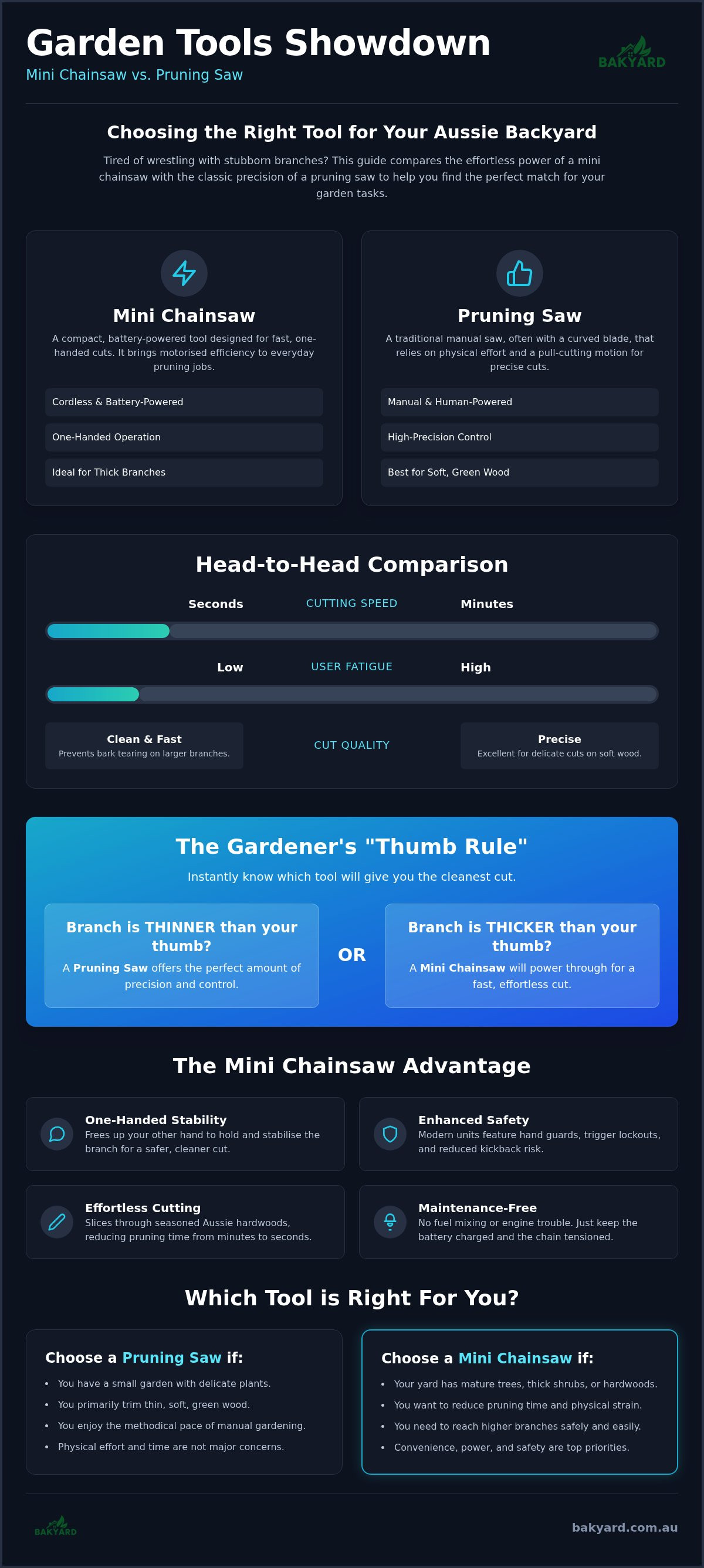
Head-to-Head Comparison: Branch Diameter, Speed, and Fatigue
When you are standing in the middle of your backyard with a pile of lopping to do, the choice between a mini chainsaw vs pruning saw often comes down to a simple "Thumb Rule". If a branch is thicker than your thumb, it usually deserves a power tool. Trying to tackle a 10cm limb with a manual saw is a great way to spend sixty seconds of intense physical effort, whereas a mini chainsaw will zip through that same wood in about five seconds. Over a whole afternoon, those saved minutes add up to hours of extra relaxation time.
The quality of the cut is just as important as the speed. A sharp chain delivers a smooth, clean surface that helps the tree seal itself off from disease and pests. Manual saws, especially as they begin to dull, can create a jagged or "chewed" appearance on the wood. This rough surface traps moisture and can lead to rot, particularly in the humid parts of Australia. Using a tool that finishes the job cleanly ensures your garden stays healthy and vibrant year-round.
Reach and safety are also vital considerations. Working at arm's length or on a ladder is inherently risky. When you use a manual saw, the back-and-forth motion can cause you to lose your balance. A lightweight power tool allows you to keep your body steady while the motor does the work. It is much easier to maintain a safe stance when you aren't wrestling with a stubborn branch.
Australian Hardwoods vs Soft Garden Varieties
Our local flora presents unique challenges that many international tool reviews ignore. Seasoned Eucalyptus and Wattle are incredibly dense and can blunt manual blades in a single afternoon of heavy use. These hardwoods require the high RPM of a chainsaw to slice through the tough fibres without stalling. On the other hand, soft and pulpy plants like Frangipanis are much more delicate. A manual saw is often better here to avoid crushing the soft stems, giving you the precision needed for a perfect prune.
Maintenance and Long-Term Value
Looking at the cost of ownership over five years, a battery-powered unit often proves to be the better investment. While you can sharpen a chain yourself with a simple file, most modern pruning saw blades are designed to be thrown away and replaced once they go blunt. To truly organise your garden tools for success, it is worth having both: a manual saw for the tiny twigs and a cordless unit for the real work. If you are ready to stop the manual struggle and upgrade your shed, you can grab a professional mini chainsaw here and make your next garden tidy-up effortless.
Making the Cut: How to Choose for Your Garden
Choosing between a mini chainsaw vs pruning saw comes down to the scale of your weekend ambitions. If you only have two small shrubs and a lot of patience, a manual saw might do the trick for a quick tidy. But for most Aussie backyards with a mix of hedges, gum trees, and dense scrub, the cordless mini chainsaw is the clear "all-rounder" for 2026. It prioritises your physical comfort, allowing you to stay in the garden longer without the usual aches and pains. We believe that gardening should be a way to relax and connect with nature, not a source of physical strain. By choosing a tool that does the heavy lifting, you can focus on the creative side of landscaping rather than the exhausting manual labour.
Before you make your final decision, run through this quick checklist to see which tool fits your lifestyle:
- Branch Thickness: Do you often tackle branches thicker than a thumb? If so, you need the extra power of a motor.
- Physical Comfort: Are you looking to reduce hand and wrist fatigue from repetitive manual sawing?
- Efficiency: Do you want to finish your pruning in minutes rather than hours?
- Storage: Do you want a tool that is easy to store and requires minimal maintenance?
If you answered yes to these, the power-equaliser of a mini chainsaw is likely your best bet for a beautiful, well-maintained backyard.
The Perfect Garden Kit
Pruning isn't just about cleaning up; it's about preparation. A mini chainsaw and a fire pit are the ultimate backyard duo. Instead of stuffing lopped branches into a green bin, you can easily cut them into perfect sizes for an outdoor fire pit. This turns a chore into a resource, giving you free fuel for a relaxing night with friends and family. Repurposing your waste this way is not only practical but adds a sense of accomplishment to your garden tidy-up. It is the best way to transform your hard work into an evening of relaxation.
Why Bakyard Australia is the Choice for 2026
We know that reliability matters when you are investing in new equipment for your home. Choosing Bakyard Australia means you get the peace of mind that comes with a one-year Australian warranty and local, Australian-based support. We don't believe in hidden fees, which is why we offer free national shipping from our warehouse straight to your door. It is about making the process as smooth as the cuts our tools deliver. If you are ready to transform your outdoor space and make maintenance a breeze, upgrade your garden kit with a Bakyard Mini Cordless Chainsaw today and start enjoying a more effortless way to garden.
Ready to Transform Your Backyard Routine?
We've explored how the right equipment can turn a weekend of hard labour into a quick and satisfying task. Whether you're dealing with the physical strain of manual sawing or the confusion of choosing between a mini chainsaw vs pruning saw, the modern battery-powered option stands out as the ultimate time-saver. It handles tough Aussie hardwoods with ease while keeping your wrists and shoulders free from fatigue.
With over 500+ happy Australian gardeners already making the switch, it's clear that the right tool makes all the difference. You get peace of mind with our one-year Australian warranty and the convenience of free national shipping to anywhere in the country. It's about giving you more time to relax and less time wrestling with stubborn branches.
Shop the Bakyard Mini Cordless Chainsaw – Free National Shipping
Enjoying your outdoor sanctuary is much better when you have the right partner in the shed. We can't wait to see how you transform your space. Happy gardening!
Frequently Asked Questions
Is a mini chainsaw safer than a regular chainsaw for beginners?
A mini chainsaw is generally safer for beginners than a full-sized unit because it is lightweight and much easier to control. The shorter guide bar, usually around 4 to 6 inches, significantly reduces the risk of kickback. It's an inviting entry point for gardeners who want more power than a hand saw but feel intimidated by a heavy petrol chainsaw. You still need to follow all safety instructions and maintain a firm, steady grip.
Can a mini chainsaw cut through thick Australian hardwood branches?
Yes, a quality cordless unit can cut through seasoned Australian hardwoods like Eucalyptus and Wattle. When comparing a mini chainsaw vs pruning saw, the power tool provides the high RPM needed to slice through dense wood without stalling. Most handheld units are designed to handle branches up to 80mm thick. This makes them perfect for clearing away fallen limbs after a storm or managing the thick, woody growth common in many Aussie backyards.
How long does the battery last on a cordless mini chainsaw?
Most cordless units come with batteries that last between 30 and 60 minutes of active cutting time. This is usually enough for a full afternoon of garden maintenance since the motor isn't running between cuts. Modern 2026-era lithium-ion cells provide consistent power right until the end of the charge. Keeping a spare battery on hand is a great way to ensure you can finish your backyard transformation without having to stop for a recharge.
Do I need to oil the chain on a mini chainsaw manually?
You do need to oil the chain manually on most mini chainsaws to keep the tool in top condition. Applying a few drops of chain oil to the bar every ten minutes of use prevents friction and stops the chain from getting too hot. This simple maintenance task keeps your cuts clean and extends the life of your motor. It's a quick step that ensures your gear is always ready for your next pruning session.
What is the maximum branch thickness a manual pruning saw can handle?
A manual pruning saw handles branches up to 25mm thick most effectively, which is about the width of a thumb. While you can technically cut larger limbs, it requires a lot of physical effort and increases the chance of the blade sticking. For branches thicker than this, the efficiency of a powered tool is much better. It ensures you get a clean cut without the hand fatigue that comes from wrestling with a manual blade.
Are mini chainsaws legal to use in residential backyards in Australia?
Yes, mini chainsaws are legal for residential use in Australia as long as they meet Australian Standard AS2726. You don't need a special licence for home gardening, but you should always check your local council's noise regulations. Since these tools are battery-powered, they are significantly quieter than petrol models, making them a polite choice for suburban areas. They allow you to get your backyard tidy-up done without disturbing the peace of your neighbourhood.
What safety gear should I wear when using a handheld chainsaw?
You should always wear appropriate personal protective equipment (PPE), including eye protection, hearing protection, and sturdy gloves. Australian safety guidelines also suggest wearing boots and chainsaw chaps or trousers for full protection. Maintaining a minimum distance of 3 metres from others while the tool is in use is essential. It's also important to maintain a stable stance and avoid using the tool above your shoulders or while standing on a ladder to ensure you stay in control.