

Handheld Chainsaw vs Full-Size Chainsaw: Which Suits Your Backyard?
The bigger chainsaw isn’t automatically the better choice for backyard jobs. A handheld chainsaw may be easier to manage for pruning and cutting smaller branches, while a full-size saw is generally intended for larger, more demanding work. Choose a compact tool for a job beyond its limits and you may struggle to make the cut. Buy more saw than you need and routine jobs can become harder to handle.
To choose well, match the saw to the material, the cut and the working conditions, then check the product specifications and instructions. This guide compares handheld and full-size chainsaws by task, handling and practical needs. It also explains what to look for before buying and using one, and where the Bakyard Australia Mini Cordless Chainsaw may fit into your backyard plans.
Key Takeaways
- Separate a saw’s compact form from its power source: “handheld” describes its form, while “cordless” describes how it’s powered.
- Choose a handheld chainsaw by matching the material and task to the product’s stated specifications.
- Compare compact and full-size saws by task scale, handling and access to understand where each may fall short.
- Before cutting, prepare a clear work area, find stable footing and wear appropriate personal protective equipment.
- Compare your backyard needs with the Bakyard Mini Cordless Chainsaw’s product information and instructions.
What Is a Handheld Chainsaw, and What Makes It Different?
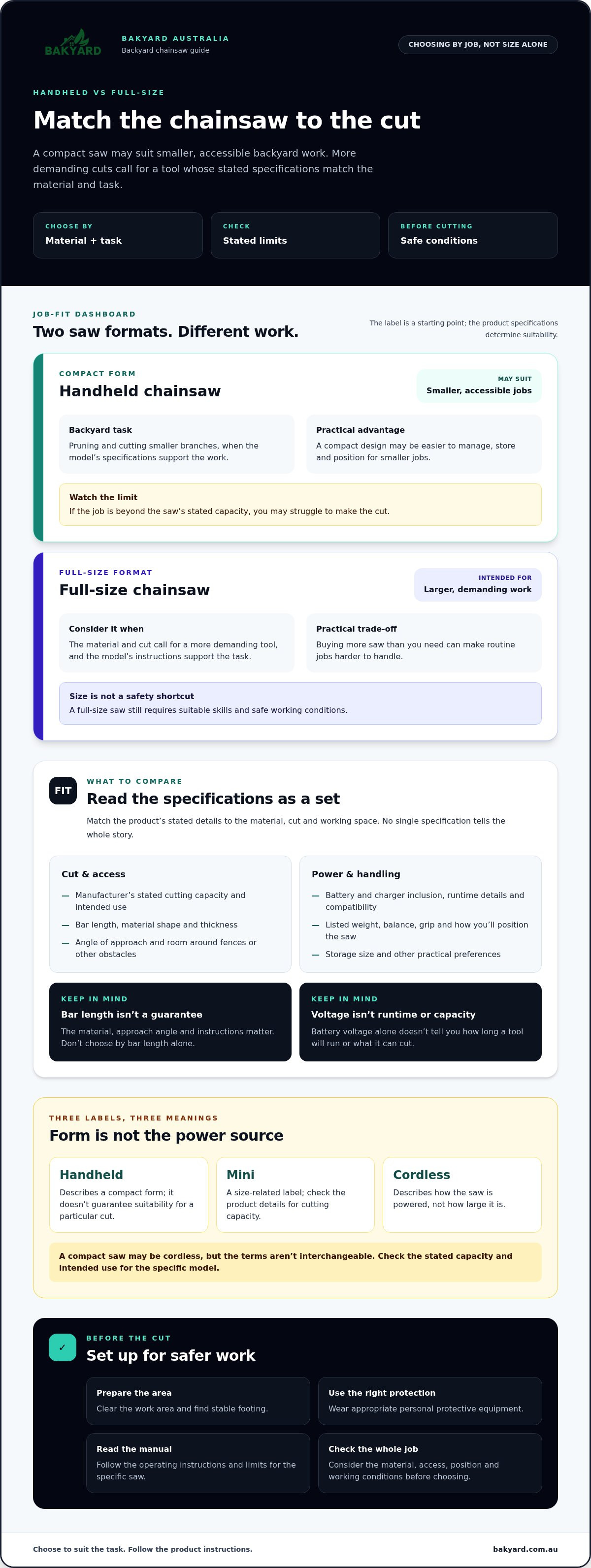
A handheld chainsaw is generally a compact chainsaw, smaller in form than a full-size model. The label describes the form, but it doesn’t tell you whether the saw suits a particular job. Cutting capacity, bar length, intended use and operating instructions matter too. A compact saw isn’t automatically right for every backyard task, just as a full-size saw isn’t the best fit for every cut.
A handheld chainsaw is a compact-form chainsaw, but its specifications determine which tasks it’s suited to. Compact and full-size saws both use a moving chain to cut material, but their dimensions, power sources and intended uses can differ. The Chainsaw overview offers background on the tool’s components and uses before you compare specific types.
What does handheld mean for a chainsaw?
“Handheld” usually signals a more compact design that may be easier to store and position for smaller jobs. The term doesn’t set a standard size or cutting capacity, though. Don’t assume two handheld models are made for the same materials or tasks. Check the product specifications and instructions to understand what each saw is designed to do.
When browsing compact tools, treat the label as a starting point, not a promise about performance. For broader context on compact saws, explore Bakyard’s cordless mini chainsaw guide. Then compare the stated details with the work you have in mind.
Handheld, mini and cordless: are they the same thing?
These terms describe different things. Handheld and mini refer to size or form, while cordless describes a power source. A compact saw may be cordless, but the terms aren’t interchangeable. A cordless chainsaw may also be full-size, and “mini” alone doesn’t confirm a saw’s cutting capacity.
- Handheld: a description of a compact form, not a guarantee of suitability for a specific cut.
- Mini: a size-related label that still needs to be checked against the product details.
- Cordless: a description of how the saw is powered, not how large it is.
For example, “cordless” tells you about the power source, not what material or task the saw can handle. Compare its stated cutting capacity and intended use with your job before deciding. Bakyard sells the Bakyard Mini Cordless Chainsaw, a compact option to assess against your backyard needs. The product details, rather than its name alone, will help you decide whether it’s a match.
Which Handheld Chainsaw Specifications Matter Before You Buy?
A product label can narrow your options, but the specifications show whether a saw matches the work you plan to do. Start with the essentials: the manufacturer’s stated cutting capacity, bar or cutting length, intended use, battery requirements and operating limits. Then weigh practical preferences, such as storage size and how manageable the tool feels in your hands.
Match the saw’s specifications to the material and task, rather than comparing numbers in isolation. A longer bar doesn’t automatically make a saw suitable for every cut. Battery voltage alone doesn’t tell you how long a tool will run or what it can cut, either. Read the product listing and manual together, and treat the stated capacity as guidance for that specific model.
How should you assess cutting capacity and size?
Start with the manufacturer’s description of the materials and tasks the saw is intended to handle. Compare its stated cutting capacity with the material you need to cut, considering its shape and position as well as its thickness. If a branch is close to a fence or another obstacle, consider whether the saw’s dimensions and bar length allow you to work safely in that space.
Bar length describes the cutting bar. It isn’t a promise that every piece of material at or below that length can be cut. The material, angle of approach and instructions for the specific saw all matter. Don’t choose by bar length alone. Follow the model’s stated limits and operating guidance.
What should you check about battery, weight and handling?
For a cordless model, check whether the listing includes a battery and charger or whether they’re sold separately. Compare any stated runtime information and battery compatibility with the work you expect to do. If you already own cordless tools, a shared battery system may be convenient, but rely on compatibility only when the manufacturer or product listing specifies it.
Weight and balance affect how manageable a tool feels, particularly when you’re making repeated cuts or working with your arms raised. Compare the listed weight and think about how you’ll hold and position the saw, not just its weight on paper. A comfortable grip and manageable balance may help during a session, but they don’t make an unsuitable task appropriate.
- Must match: intended use, stated cutting capacity, bar length, battery compatibility, material and access.
- Compare: battery and charger inclusions, runtime details, tool weight and handling.
- Personal preferences: storage size and other conveniences that don’t override the saw’s stated limits.
Safety belongs in the comparison too. Read the operating manual before use and choose suitable protective clothing and equipment. The CDC’s Preventing Chainsaw Injuries guidance also outlines chainsaw safety precautions. Once you know what the job requires, compare those needs with the Bakyard Mini Cordless Chainsaw details.
Handheld Chainsaw vs Full-Size Chainsaw: Which Jobs Suit Each?
A backyard setting doesn’t automatically make a compact saw the right tool. A handheld chainsaw may suit smaller, accessible work if the manufacturer’s specifications support the material and task. Full-size saws are intended for more demanding cutting, but their size doesn’t remove the need for suitable skills and safe working conditions. Choose according to the cut, not simply where you’ll use the tool.
Use this comparison as a starting point, then read the instructions for the specific saw. Suitability depends on the model, material, access and your ability to control the tool safely.
| Consideration | Compact handheld saw | Full-size chainsaw |
|---|---|---|
| Task scale | May suit smaller-scale pruning or garden upkeep when the model is specified for that work. | May be more appropriate for larger, thicker material and demanding cutting within its stated limits. |
| Handling | Compact form may help with positioning in an accessible, controlled work area. | Typically larger to handle, so consider your experience and ability to maintain control. |
| Reach | Doesn’t make elevated or awkward cuts safe or suitable. | More reach isn’t a reason to cut from an unstable position or beyond your control. |
| Practical limits | Can be unsuitable if the material or task exceeds the model’s instructions. | Still has limits; demanding or hazardous work may call for qualified assistance. |
When can a handheld chainsaw be the practical choice?
A handheld saw may be practical for tasks such as tidying smaller branches or routine garden upkeep, provided the model is specified for that work. These are examples, not a guarantee that every compact saw can handle those jobs. Check the stated use and cutting limits first. Work only where you can stand securely and control the tool as directed. Bakyard’s Mini Cordless Chainsaw is a compact option to compare with your intended task and its product specifications.
When is a full-size saw or another approach more suitable?
Large or thick material, unstable branches, awkward access and elevated work are reasons to pause and reassess. Being able to reach a cut doesn’t mean you can make it safely. If a job involves felling a large tree or requires more control than you have, a compact tool may be unsuitable. The task may need a different tool or qualified assistance.
Don’t improvise if the material exceeds the manufacturer’s stated capacity, the cut position feels unstable or you’re unsure how the saw will respond. Stop and review the instructions. If the job remains outside the tool’s limits or your experience, leave it to someone qualified to handle it. Even for home use, match the saw to the actual cut rather than assuming every backyard job is small or straightforward.
How to Choose and Use a Handheld Chainsaw More Confidently
A sound choice starts before you pick up the saw. Follow these steps to match the tool to the work, and pause if the task or conditions don’t feel manageable. A compact size doesn’t remove the need for preparation, protective equipment or safe technique.
- Define the job. Identify what you need to cut, where it is and how you’ll access it. If the work involves a tree at height or a large limb, reconsider whether a handheld saw is suitable.
- Check the material. Look for loose, unstable or tensioned branches, and consider whether the material could shift during cutting. Don’t proceed if you can’t establish a stable setup.
- Compare the specifications. Confirm that the saw’s stated capacity and intended use cover the job. Read the instructions for the specific model rather than relying on its size or product label.
- Prepare safely. Read the manual, inspect the saw and chain, clear the work area, keep others well away and make sure you have stable footing. Wear appropriate personal protective equipment.
- Reassess as you go. Stop if the material moves unexpectedly, conditions change or you can’t maintain control. Don’t continue just because you’ve already started.
What safety checks should happen before cutting?
Before each use, follow the manufacturer’s manual to check the saw’s condition, chain and safety features. Arrange the material so it’s stable, and keep bystanders outside the work area. Wear suitable eye, face, hearing, hand, leg and foot protection as appropriate to the task and the manual. Don’t cut above shoulder height, from an unstable position or beyond your training and control.
Wind, rain, poor visibility, slippery footing and fatigue can make a saw harder to handle safely. If any of these affect your balance or concentration, put the tool aside until conditions improve.
When should you pause or choose a different solution?
Stop if a branch is unstable, under tension, beyond the saw’s stated capacity or positioned where you can’t control the cut. Overhead, complex or high-risk work may need a different method or a trained professional. A smaller saw still has a moving chain and requires safe technique. Don’t stretch beyond the manual or your experience.
Australian safety guidance can depend on the work and where you live. For current advice, consult Safe Work Australia and the relevant work health and safety regulator in your state or territory. If a job feels outside your skills, choose a safer option. For suitable compact-tool tasks, explore Bakyard’s chainsaw option and compare its product information with the job.
Is Bakyard Mini Cordless Chainsaw the Right Compact Option for You?
Once you’ve considered the task, material and tool requirements, you can compare them with a specific product. Bakyard sells the Mini Cordless Chainsaw as a compact chainsaw option. Its name alone doesn’t establish what it can cut or how it should be used, so use the product specifications and instructions to assess whether it suits your plans.
A compact chainsaw may fit your needs if the work is within the model’s stated limits and you can handle the saw safely in the conditions at hand. If the job involves material beyond those limits, difficult access or more control than you’re confident you can manage, reassess rather than trying to make the tool fit.
How to decide whether a compact Bakyard saw fits your plans
Begin with the work you intend to do. Compare the material, cutting position and access with the product information, then read the operating instructions to understand the stated use and limits. Don’t infer capacity, runtime or handling characteristics from the words “mini” or “cordless”. The Bakyard Mini Cordless Chainsaw is an option if you’re looking for a compact chainsaw and its published details align with your needs.
Specifications are only one part of the decision. You also need a stable working position, a clear area and the ability to follow the manual and maintain control. If those conditions aren’t in place, delay the job or choose a different approach.
What to do before making your final choice
Use this checklist to bring the decision together:
- Task: Identify exactly what you plan to cut and whether it’s accessible from a stable position.
- Material: Compare it with the product’s stated cutting capacity and intended use.
- Access and handling: Consider whether you can position and control the saw without reaching overhead or working awkwardly.
- Specifications: Read the product details and manual, including stated limits and operating requirements.
- Safety: Prepare a clear work area, wear suitable protective equipment and stop if the job or conditions feel beyond your control.
If the work exceeds the product’s stated limits, choose a different tool or leave the job to someone qualified rather than pushing ahead. This matters especially for large, unstable or elevated material, where access and control can make the task more demanding.
Bakyard products include free shipping and a one-year Australian warranty. These are useful purchase details, but they don’t replace checking whether a particular saw suits your task. Decide what the work requires first, then review the Bakyard Mini Cordless Chainsaw product information as you weigh up your compact-tool option.
Ready to explore? Visit Bakyard’s outdoor and gardening range to find a tool for your plans.
Choose the Right Tool for Your Next Backyard Job
Before buying, write down the jobs you expect to tackle. A clear list helps you choose for the work ahead instead of relying on a tool’s name or assuming one saw will suit every task. Compare the options with the manufacturer’s specifications and instructions, and leave any job outside your experience or the tool’s limits for a safer, more suitable approach.
If a compact saw fits your plans, the Bakyard Mini Cordless Chainsaw is available in Bakyard’s garden-tool range. Bakyard products include free shipping and a one-year Australian warranty, useful details to consider as you weigh up your purchase. The right handheld chainsaw for your backyard is one that matches the intended work and that you can use as directed.
Ready to take the next step? Explore Bakyard’s outdoor and gardening range and find an option for your plans.
Frequently Asked Questions
Are handheld chainsaws safe for beginners?
Not automatically. A handheld chainsaw can still cause serious injury, and a compact size isn’t a safety guarantee. Before starting, learn the controls and stopping procedure from the manual, and wear the protective equipment it recommends. A beginner should practise only on material the saw is specified to handle, in a clear area with a stable setup. If you’re unsure how the material may move during a cut, stop and get appropriate guidance before proceeding.
Can you use a handheld chainsaw one-handed?
Don’t assume you can use one one-handed just because it’s compact. Follow the specific model’s instructions for grip and operating position, and don’t change your hold to reach around an obstacle or steady a branch. If a cut would leave you balancing the saw while holding material with your other hand, stop and rethink the setup. If you can’t keep a secure grip and stable footing, don’t make the cut.
How long does a handheld chainsaw battery last?
There’s no single runtime that applies to every handheld chainsaw. Battery capacity, the material being cut, cutting conditions and how the saw is used can all affect how long it runs. Use the manufacturer’s runtime guidance as an estimate for that model, and check whether the listing includes a battery and charger. Don’t use figures from another saw to plan your work. Allow for conditions to differ from those stated by the manufacturer.
How do you maintain a handheld chainsaw chain?
Use the model’s manual as your guide, because chain inspection and maintenance procedures can differ. Before checking or cleaning the chain, switch off the tool and follow the manual’s steps to make it safe to handle. Look for visible damage or unusual wear, and don’t operate the saw if you find either. Use only the maintenance method and replacement parts specified for that model. If you’re uncertain, pause rather than improvising.
Does a handheld chainsaw need chain oil?
Some models require chain oil, while the lubrication method depends on the saw. Check the product specifications and manual for the correct lubricant and maintenance routine rather than applying oil by habit. If the manual says lubrication is required, don’t use the saw if the system isn’t working as directed. Follow the product’s instructions for any checks needed before cutting.
Can a handheld chainsaw be used in wet weather?
Only use a saw in conditions allowed by its manual. Battery power doesn’t automatically mean weatherproofing. Rain can make handles, ground and material harder to manage, while damp conditions or poor visibility can affect control. If you can’t maintain secure footing or see the cut clearly, postpone the job. Follow the product’s guidance for handling and storing the battery and electrical components, and don’t expose them to conditions the manufacturer doesn’t permit.