

Fire Pit Regulations Australia: A Complete Guide to Staying Safe and Legal (2026)
Did you know that a simple Friday night marshmallow roast could land you a fine worth thousands of dollars if you haven't checked the local rules? It's a common worry for many Aussie homeowners who just want to enjoy a bit of warmth and ambience in their outdoor space. We all agree that there's nothing quite like the crackle of a wood fire to bring people together, but the complex web of fire pit regulations Australia has in place can make even a small gathering feel like a legal minefield.
You deserve to relax in your garden with total peace of mind, and that's exactly what this guide provides. We'll help you master the rules so you can host unforgettable nights without the fear of heavy fines or safety hazards. We're going to dive into the crucial differences between Total Fire Bans and local council bylaws, explain the essential safety distances from fences and trees, and show you how a compliant 2-in-1 fire pit and BBQ can be your secret weapon for year-round enjoyment.
Key Takeaways
- Understand the hierarchy of rules between state fire authorities and local councils to ensure your backyard setup is fully compliant.
- Learn how to navigate fire pit regulations australia by distinguishing between Total Fire Bans and seasonal Fire Danger Periods.
- Discover the standard setback distances required to keep your fire safely away from boundaries and how to avoid smoke nuisance complaints from neighbours.
- Find out how the BBQ exemption works and why a 2-in-1 fire pit and BBQ combo can be a game-changer for legal year-round use.
- Identify the must-have safety features, such as spark screens and heat shields, that help you choose a legal and reliable product for your home.
Understanding the Australian Fire Safety Framework
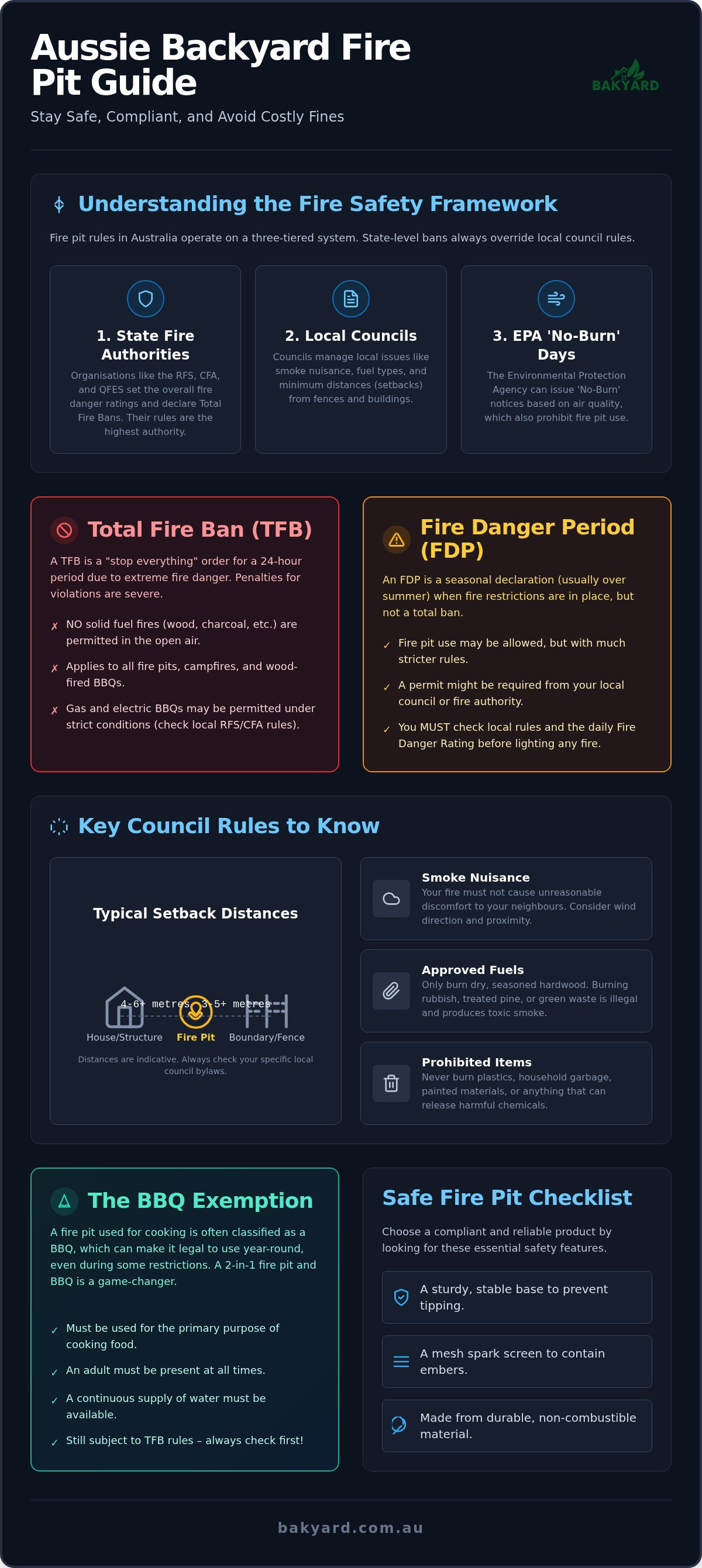
Understanding the hierarchy of fire pit regulations australia is the first step to a stress-free night by the flames. It isn't just one set of rules. Instead, it's a three-tiered system involving state fire authorities, local councils, and environmental protection agencies. Your location changes everything. A property on the edge of a national park has different requirements than a townhouse in the city. Our Australian bushfire history shows how quickly a small spark can turn into a disaster. This history is exactly why laws are so strict. In the Australian context, a compliant fire pit is a dedicated, stable container used in strict accordance with local setback distances and daily fire danger ratings to prevent the escape of embers.
State-Based Fire Authorities
Groups like the NSW Rural Fire Service (RFS), Victoria's Country Fire Authority (CFA), and the Queensland Fire and Emergency Services (QFES) manage the overarching safety laws. They decide when it's simply too dangerous to light up. Every morning, you should check the Fire Danger Rating (FDR) for your region. If the rating is high or a Total Fire Ban is declared, your fire pit must stay cold. These authorities focus on preventing large-scale emergencies. Their word is final regarding open-air fires. If you're looking for a setup that meets these high standards, exploring a range of quality fire pits is a great place to start.
The Role of Local Councils
While state authorities look at the big picture, your local council looks at your street. They focus on 'smoke nuisance' and how your fire affects the people next door. If your smoke is blowing directly into a neighbour's bedroom window, you could be breaching local bylaws regardless of the fire danger level. Many councils also have specific rules about what you can burn. Common restrictions include:
- Fuel types: Some allow seasoned hardwood, while others might restrict you to gas or charcoal in high-density areas.
- Prohibited items: Burning treated pine, rubbish, or green waste is almost always illegal.
- Setback distances: Specific requirements for how far your fire must be from fences and structures.
Check your specific council website before burning. Rules can change from one suburb to the next. Being a good neighbour means keeping the smoke down and the safety standards up. If you're unsure, a quick phone call to the council planning office can save you from a costly fine.
Total Fire Bans vs. Fire Danger Periods
Many people think a "ban" is just a "ban", but there's a massive difference between a one-day emergency and a three-month seasonal restriction. Understanding these nuances is a core part of mastering fire pit regulations australia. If you get it wrong, you aren't just risking a telling-off from the neighbours. You're potentially looking at massive on-the-spot fines or even criminal charges in extreme cases. It pays to stay informed because the rules can change overnight as the weather shifts.
Total Fire Bans (TFB)
A Total Fire Ban is a "stop everything" order. These are typically declared on days of extreme heat and high winds when any spark could start a fast-moving bushfire. On these days, your wood-fired pit must stay completely cold. There's a zero-tolerance approach to enforcement because the stakes are so high. The Total Fire Ban rules clearly state that activities like grinding, welding, or using any solid-fuel burner are strictly prohibited in the open air.
There is usually a small exception for gas-fired BBQs, provided they are used in a cleared area away from flammable materials and an adult is always present with a hose or bucket of water. However, even these exceptions can be revoked if the conditions are dangerous enough. Always check the official state fire authority website or app, such as Hazards Near Me in NSW or the CFA website in Victoria, before you even think about striking a match.
Fire Danger Periods and Restrictions
Unlike a TFB, which typically lasts for 24 hours, a Fire Danger Period (FDP) is a seasonal window. It often runs throughout the summer months when the landscape is dry. During an FDP, you might still be allowed to use a fire pit for warmth or recreation, but the rules are much tighter than they are in July. You'll often need to ensure your fire is in a properly constructed pit, has a cleared perimeter of several metres, and is never left unattended.
Don't forget about "No-Burn" days declared by the EPA. These aren't about bushfire risk, but rather air quality. On still, cold days, smoke can get trapped in valleys and urban areas, leading to health warnings. If the EPA declares a No-Burn day, your fire pit needs to stay off to keep the air breathable for everyone. When the weather is right and the bans are lifted, you might want to explore some quality fire pits that are designed with these safety and compliance standards in mind.
Council Bylaws and Property Requirements
Local councils bridge the gap between state laws and suburban reality. They focus on how your fire affects the immediate environment and your fellow residents. Under fire pit regulations australia, "nuisance smoke" is legally defined as smoke that unreasonably interferes with a person's health, comfort, or the use and enjoyment of their property. It is a subjective rule that relies on common sense and courtesy. If your smoke is thick enough to enter a neighbour's open window or prevent them from hanging out their laundry, you are likely breaching local bylaws. Keeping your fire small and controlled is the best way to stay on the right side of the law while still enjoying the outdoors.
Safe Clearance Zones
Setback distances are the most common council requirement you will encounter. Most local bylaws require a minimum of 2 to 3 metres from any property boundary, fence, or structure. For example, the Brisbane City Council fire pit regulations emphasise using fire pits safely to avoid creating smoke that affects others. This isn't just about the distance to the fence. You also need to look up. Overhanging trees or pergolas can catch fire from rising embers surprisingly quickly. A 2-metre "clear earth" zone around the pit is the gold standard for safety. This means removing all long grass, leaf litter, and mulch. If you are dreaming of a fire on a timber deck or balcony, proceed with extreme caution. Most councils forbid this unless the pit is on a non-combustible surface like stone or concrete pavers that extend well beyond the heat zone.
Acceptable Fuel Sources
What you burn is just as important as where you burn it. Most councils strictly prohibit burning rubbish, treated pine, or green waste. These materials create thick, acrid smoke and can release toxic chemicals into the air. Treated pine is particularly dangerous as it contains arsenic and other preservatives. Instead, stick to seasoned hardwood like ironbark or red gum. These timbers have a low moisture content, meaning they burn hotter and produce far less smoke. Charcoal is another fantastic option for urban dwellers. It provides a steady heat and a beautiful glow without the heavy smoke output of wood, making it much more council-friendly. Choosing a versatile fire pit allows you to switch between these fuel types easily. By using the right fuel, you ensure your night is about relaxation rather than dealing with frustrated neighbours or council inspectors.
The BBQ Exemption: Using Your Fire Pit for Cooking
One of the most misunderstood parts of fire pit regulations australia is the "cooking exemption". Many people assume that if they have a fire, they're in the clear as long as there's a pack of sausages nearby. In reality, the law is quite specific. A "cooking fire" is generally treated with more leniency than a purely recreational one, but only if you're actually using it to prepare food. This distinction is vital during high-risk periods when authorities might allow a BBQ but ban a campfire. By understanding this, you can turn your backyard gathering into a legal and delicious event.
When is a Fire Pit a BBQ?
For a fire to be legally classed as a BBQ, the primary purpose must be cooking. This means you can't just light a massive blaze and throw a single marshmallow on at the end. To stay compliant, you should have food, cooking utensils, and a proper grill grate ready to go. This is where a 2-in-1 design like the Bakyard Omnipit becomes your best friend. Because it's designed as both a fire pit and a BBQ, it satisfies the physical requirements for a cooking appliance while still giving you that beautiful firelight you love. Adding a grill grate effectively changes the legal status of your setup in many jurisdictions, moving it from a "recreational fire" to a "cooking appliance".
Rules for Cooking During Restrictions
Even if you're cooking, you aren't exempt from common sense or safety laws. During Fire Danger Periods, most states require continuous adult supervision. You must also have a reliable water supply, like a garden hose or a large bucket, within arm's reach at all times. It's also worth noting that on Total Fire Ban (TFB) days, many states still prohibit wood-fired or charcoal BBQs entirely. In these extreme conditions, only gas or electric options are usually permitted. Always double-check your state's specific TFB rules to see if solid fuel is off the table. If you're ready to upgrade your outdoor cooking game while staying safe, check out the full range of Bakyard fire pits designed for Aussie backyards.
Choosing a Compliant and Safe Fire Pit for Your Home
Armed with a clear understanding of fire pit regulations australia, you're ready to transform your backyard into a cosy retreat. Picking the right pit isn't just about style. It's about finding a product that works with the rules rather than against them. A well-designed unit makes it easier to maintain those crucial safety distances and keep your neighbours happy. From the weight of the base to the inclusion of a spark screen, every feature plays a role in keeping your gatherings legal and safe.
Essential Safety Features
Safety starts with containment. High-quality mesh lids are essential because they prevent ember attack, stopping glowing coals from drifting onto dry grass or your neighbour's deck. You should also look for heavy-duty steel construction. Cheap, thin materials can warp or fail under high heat, creating a fire hazard. A stable, wide base is just as important to prevent accidental tip-overs during a busy night. You can explore our range of outdoor fire pits designed specifically for Aussie conditions to find a model that ticks all these boxes.
Maintenance is the secret to long-term compliance. Always clear out old ash before lighting a new fire, as a build-up can restrict airflow and create more smoke. Check your pit regularly for signs of structural weakness. If you find any holes or cracks, it's time for an upgrade. Keeping your equipment in top shape ensures you're always ready for a safe burn when the weather is right.
The Bakyard Advantage
Portability is a huge plus when navigating council setback rules. If you need to move your fire away from a boundary fence or an overhanging tree, a portable design makes it simple. The Bakyard FireFlex is a fantastic choice for smaller urban spaces where every centimetre of clearance counts. It offers the 2-in-1 functionality you need to make the most of the BBQ exemption we discussed earlier, allowing you to switch between fire and food with ease.
We're an Australian-owned business, so we understand the local climate and the strict standards required for safe burning. Every product comes with a 1-year Australian warranty and free shipping from our Sydney warehouse. This means you get a reliable, compliant centrepiece for your outdoor space without the long wait. By choosing a pit that balances safety with versatility, you're setting yourself up for years of stress-free relaxation and community connection in your own backyard.
Ready to Ignite Your Perfect Backyard Evening?
Now that you've mastered the essentials, you can host your next gathering with total confidence. You know how to distinguish between a seasonal fire danger period and an emergency ban. You understand that keeping the right setback distances and using seasoned hardwood will keep both the council and your neighbours happy. Most importantly, you've seen how a 2-in-1 design can help you make the most of the legal cooking exemption.
Navigating fire pit regulations australia is all about balance. It's about respecting the land and your community while creating a space for connection. Our products are designed for Australian outdoor living and built to handle our unique conditions. When you choose us, you get the peace of mind that comes with a 1-year Australian warranty and free shipping from our Sydney warehouse.
Browse our range of compliant 2-in-1 Fire Pits & BBQs and start planning your next unforgettable night under the stars. Your dream outdoor space is just a spark away!
Frequently Asked Questions
Can I use a fire pit on a Total Fire Ban day in Australia?
No, you cannot use a wood-fired or charcoal fire pit during a Total Fire Ban. These bans are strictly enforced to prevent catastrophic bushfires during extreme weather. All solid-fuel fires are prohibited in the open air, and this includes your backyard fire pit. While some states allow gas or electric BBQs under very specific safety conditions, your wood fire must stay cold. Breaking these rules can lead to massive fines or even criminal charges.
How far should a fire pit be from a fence or house?
Yes, it is generally legal to enjoy a fire pit in an Australian suburban backyard. However, your right to light up depends on following state fire authorities and local council rules. You must ensure your fire doesn't create a smoke nuisance for neighbours and that you aren't burning during a ban. Using a high-quality, contained unit like a Bakyard 2-in-1 fire pit and BBQ makes it much easier to satisfy these local safety requirements.
Do I need a permit to have a fire pit in my garden?
Most urban residents don't need a specific permit for a small, recreational fire pit. However, if you live in a bushfire-prone area or on a large rural block, a "Permit to Burn" might be required during the warmer months. These permits are usually issued by your local fire warden or state fire service. It is always best to check your local council's website, as regulations can change depending on your property's specific zoning and the current season.
What can I legally burn in my fire pit?
You are legally allowed to burn seasoned hardwood, charcoal, and manufactured fire logs. It is illegal in almost every jurisdiction to burn household rubbish, plastic, or treated pine. These materials release toxic chemicals and create thick, acrid smoke that breaches environmental laws. Using dry, seasoned timber is the best way to follow fire pit regulations australia. It ensures a hotter, cleaner burn that is much less likely to attract unwanted attention from the authorities or frustrated neighbours.
Can my neighbours complain about my fire pit smoke?
Yes, your neighbours have a legal right to complain if your fire creates a "smoke nuisance". This happens when smoke enters their home or prevents them from enjoying their own backyard. To keep things friendly, always check the wind direction before lighting up. Using dry wood and a well-ventilated pit will significantly reduce smoke output. Being a considerate neighbour is just as important as following the technical rules, as it prevents council inspectors from visiting your property.
Are 2-in-1 fire pit BBQs exempt from some fire restrictions?
They often are, thanks to the "cooking exemption" that applies in many regions during seasonal Fire Danger Periods. While they don't override a Total Fire Ban, a fire lit specifically for food preparation is often treated differently than a purely recreational one. Using a Bakyard Omnipit or Ember Ring allows you to use this exemption legally. You must have food and cooking utensils present to prove the fire is for cooking, ensuring you stay on the right side of the law.
What is the best way to safely extinguish a fire pit?
The safest method is to let the fuel burn down to ash and then douse it thoroughly with water. Use a shovel to stir the ashes while you apply the water to ensure every hidden ember is completely extinguished. Don't just cover the hot coals with sand or dirt, as this can trap heat and create a dangerous "hot spot" that lasts for days. Once the ash is cool to the touch, you can safely dispose of it and pack away your pit.