

Best Time to Prune Trees in Australia: A Seasonal Guide
Winter isn’t automatically the safest or smartest time to prune a tree. The best time to prune trees in australia depends on the species, your reason for pruning and conditions where the tree is growing.
It’s easy to get mixed messages: one tree may benefit from pruning while dormant, while another could lose flowers or fruit if you cut at the wrong point in its growth cycle. Australia’s varied climates also mean a single seasonal calendar won’t suit every backyard.
This guide explains how to choose a suitable pruning window and avoid common seasonal mistakes. You’ll learn what to consider for deciduous, evergreen, flowering and fruit trees, how local conditions can affect your plans, and how to approach the job safely. You’ll also find guidance on when suitable home tools may be enough and when a larger or riskier job calls for expert help.
Key Takeaways
- The best time to prune trees in australia depends on the species, your pruning goal and current growing conditions, not just the season.
- Use Australia’s seasonal patterns as a starting point, then account for differences between temperate, tropical, arid and alpine climates.
- Before making cuts, identify the tree, check its growth stage and look for species-specific timing advice.
- Match your tools to the branch and task, follow the tool instructions and wear appropriate protective equipment.
- A mini cordless chainsaw may suit some small pruning tasks, but it isn’t right for every branch or tree.
When is the best time to prune trees in Australia?
The best time to prune a tree depends on its type, your purpose and current conditions. Australian seasons are a useful planning guide, not a universal pruning calendar. Deciduous, evergreen and fruit trees can respond differently to the same cut, so identify what you’re growing before choosing a date.
Pruning means selectively removing branches to meet a clear tree-care goal. You might be shaping the canopy, improving structure, clearing a path or removing damaged growth. Timing can also affect flowering and fruit production. If a branch is damaged or unsafe, don’t wait for a preferred season. Assess the risk and get qualified help if the work is beyond your skills or equipment.
Why there is no single pruning month for every Australian tree
Deciduous trees lose their leaves and have a distinct dormant period. Evergreens retain foliage and may grow at different times. Flowering trees can form buds well before blooms appear, while fruit trees have cycles of flowering, fruit development and harvest. Pruning at the wrong stage may remove buds or reduce a crop. For a general overview of how pruning goals influence fruit-tree cuts, see Fruit tree pruning techniques and timing.
Climate adds another consideration. Temperate areas tend to have clearer seasonal shifts, while tropical climates may follow wet and dry patterns. Arid conditions can bring heat and water stress, and alpine areas have colder winters and a shorter growing season. Use these broad patterns to plan, but give more weight to the weather and the tree’s actual growth stage than to the calendar month.
Choose the tree’s timing first, then use the season as a guide.
What to decide before choosing a pruning date
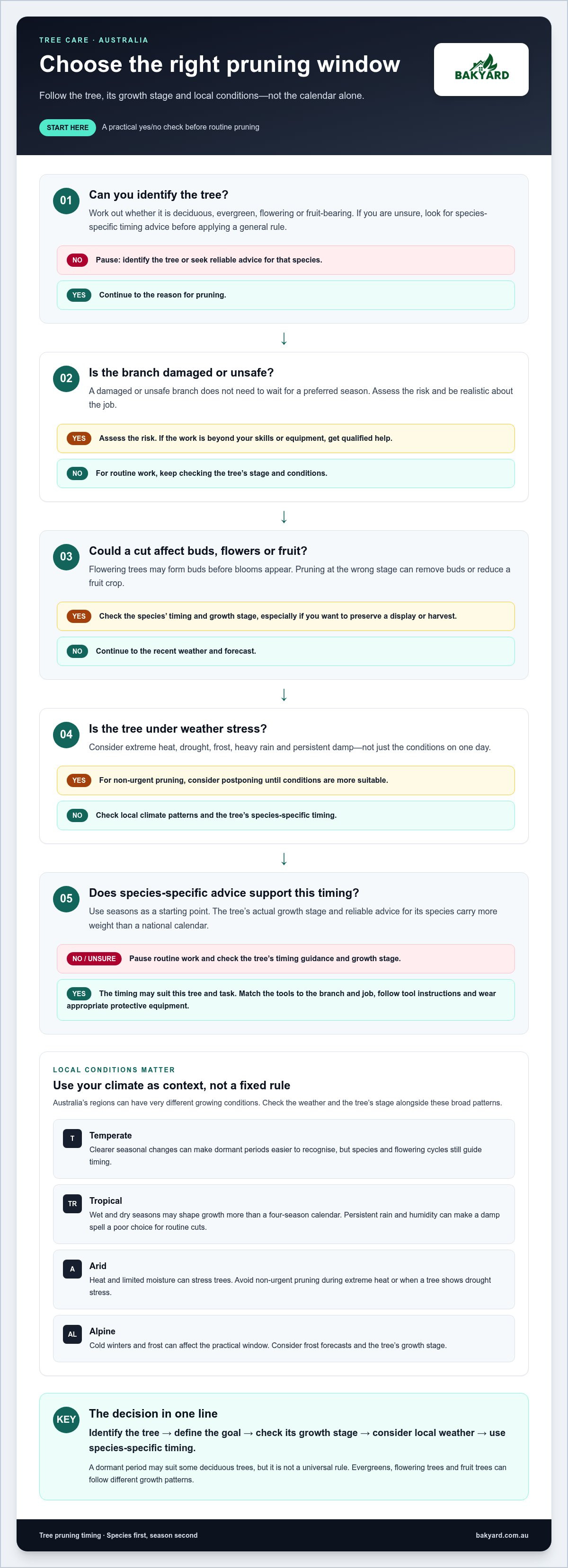
Start by identifying the species, or at least whether the tree is deciduous, evergreen, flowering or fruit-bearing. If you’re unsure, don’t apply a generic rule. Leaf shape, flowers and fruit can help with identification, and species-specific guidance is a safer basis for timing.
Next, decide what you want to achieve. Routine shaping, improving structure, clearing an obstruction and encouraging flowers or fruit are different goals. Check whether the tree is flowering, carrying developing fruit or setting buds, particularly if you want to preserve a display or harvest. Consider recent conditions too. Extreme heat, drought, frost or heavy rain may make it sensible to postpone non-urgent work.
- Identify the tree and look up timing advice for that species.
- Define the goal, such as improving health or structure, clearing an obstruction, or supporting flowering or fruit production.
- Check its stage and the forecast before cutting. Reconsider if the tree is under weather stress or actively developing flowers or fruit.
This turns “Which month?” into a more useful question: “Is this the right stage and a suitable day for this tree and this job?”
How Australian seasons and climate affect tree pruning
Season names can help you plan, but they’re only a broad guide. Australia spans climates with different rainfall, temperatures and growing patterns, so the same month can bring very different conditions for trees. The best time to prune trees in australia is better judged by combining the tree’s growth stage with local weather, rather than following a national calendar alone.
Conditions matter because pruning leaves fresh cuts. A tree already coping with heat, frost or persistent damp may be under extra stress. For non-urgent work, choosing a milder spell can be a sensible precaution. Species-specific guidance should still determine whether that timing suits the tree.
Using the seasons as a starting point
For some deciduous trees, a dormant period can be a useful time to prune because the tree isn’t actively carrying leaves. However, dormancy and suitable timing vary between species. A seasonal rule shouldn’t override reliable advice for the particular tree. Evergreen trees may have different growth patterns and don’t share the same leafless window.
Flowering and fruiting can shift the plan as well. A cut made before a flowering period may remove buds. Pruning while fruit is developing can affect the crop or make the work less practical. Treat seasonal recommendations as a starting point, then check the tree’s stage and your reason for pruning.
Adjusting for local weather and growing conditions
Australia’s broad climate patterns call for different planning. These are useful comparisons, not fixed rules for every garden:
- Temperate conditions: Distinct seasonal changes can make dormant periods easier to recognise, but species and flowering cycles still guide timing.
- Tropical conditions: Wet and dry seasons may shape growth more than a four-season calendar. Persistent rain and humidity can make a damp spell a poor choice for routine cuts.
- Arid conditions: Heat and limited moisture can place trees under stress. Avoid scheduling non-urgent pruning during extreme heat or when a tree is showing signs of drought stress.
- Alpine conditions: Cold winters and frost can affect the practical pruning window. Consider frost forecasts and the tree’s growth stage rather than assuming winter is automatically suitable.
Rainfall matters as much as temperature. If persistent rain is forecast, postponing routine pruning may help you avoid working in wet conditions. High humidity and damp weather can also keep cut surfaces wet for longer. Strong heat, meanwhile, can add stress to a tree that is already short of water. Look beyond a single day’s forecast and consider whether the tree has recently faced extreme conditions.
Local weather can depart from the usual seasonal pattern. An unusually warm spell may bring forward visible growth, while a late frost may affect buds or new shoots. If the tree is flowering or carrying fruit, check whether pruning now could remove growth you want to keep.
Check the tree’s stage and the forecast as well as the season. This helps turn broad seasonal advice into a careful plan for your backyard.
When to prune deciduous, evergreen, flowering and fruit trees
A tree’s group gives you a better starting point than a month on the calendar, but it doesn’t replace advice for the species. The best time to prune trees in australia can differ even between trees that look similar, particularly when you’re trying to preserve flowers or fruit. Use this comparison to narrow down the timing, then check what applies to your particular tree.
| Tree group | Pruning goal | Broad timing cue | Key caution |
|---|---|---|---|
| Deciduous | Shape, structure or remove selected growth | For some species, consider the dormant period when leaves have fallen. | Species differ; don’t assume leaf drop alone means it’s the right time. |
| Evergreen | Maintain shape or address specific growth | Follow species-specific advice and the tree’s growth cycle. | Evergreens don’t share one universal pruning season. |
| Flowering | Maintain form while keeping the next display in mind | Use the flowering cycle to guide timing; learn when buds form. | Pruning at the wrong stage may remove buds or flowering growth. |
| Fruit | Maintain structure or manage fruiting wood | Check the species’ fruiting habit and the purpose of each cut. | Maintenance cuts and cuts intended to influence fruit production aren’t interchangeable. |
Deciduous and evergreen trees: different growth patterns
Leaf drop can make the dormant period easier to recognise in deciduous trees, and this may suit some pruning tasks. It also makes the branch structure more visible. But dormancy is a clue, not a blanket instruction. Species, climate and the reason for pruning still matter, so check whether the particular tree should be pruned while dormant or at another stage.
Evergreens retain their foliage, but that doesn’t mean they all grow or respond to pruning in the same way. Some may have seasonal growth flushes or other sensitive stages. Identify the tree before cutting, and don’t apply a deciduous-tree rule simply because it’s commonly recommended.
Flowering and fruit trees: protect the next season’s display
Flowering trees vary in when they bloom and when they form buds. If you prune near flowering, you could remove growth that would have produced the display. Fruit trees differ too: a light maintenance cut to remove unsuitable growth has a different purpose from pruning intended to manage fruiting wood. Flowering and fruiting habits can vary by species and cultivar.
General guidance may suggest a dormant window for some deciduous trees, but species and cultivar determine whether flowering, fruiting wood or active growth makes that timing unsuitable. Before pruning, check what growth the tree flowers or fruits on, and whether buds, blossoms or developing fruit are present. If your main aim is a better harvest, use advice specific to that fruit tree rather than a general rule for all fruiting plants.
Keep the goal clear. Removing a broken branch is different from shaping the canopy or changing how the tree bears fruit. For flowering and fruiting trees, a small, well-timed cut may be more appropriate than broad shaping, especially if you’re unsure which branches carry next season’s buds or fruiting wood.
How to choose a safe pruning window and avoid common mistakes
A suitable date is only one part of a safe pruning plan. Before picking up a tool, make sure you know what the tree needs, whether it’s at a suitable stage and whether you can reach the work safely. A conservative approach helps protect the tree and keeps a small garden task from becoming a risky one.
A pre-pruning checklist for Australian gardens
Work through these checks in order. If you can’t identify the tree, understand the cut or reach the branch safely, pause and get advice before proceeding.
- Identify the tree. Confirm the species or type, then look up its pruning guidance. Don’t rely on a seasonal rule meant for a different tree.
- Set a clear goal. Decide whether you’re addressing damaged growth, improving structure or clearing a minor obstruction. Avoid cutting simply to make the canopy smaller.
- Check its growth stage. Look for buds, flowers and developing fruit. Consider whether the cut could remove growth needed for the next display or harvest.
- Check the forecast. Postpone non-urgent work if extreme heat, frost, strong wind or persistent rain could make conditions unsuitable for the tree or for you.
- Assess the work area. Look for unstable ground, nearby people, overhead hazards and branches that may fall unpredictably. Use appropriate protective equipment and stable access, and don’t overreach from a ladder.
Timing and technique mistakes that can set a tree back
Heavy pruning without a clear reason can remove too much foliage, alter the tree’s shape and leave it under avoidable stress. Start with the minimum work needed for your goal. Before cutting, consider how the branch connects to the tree and what else may be affected. If the structure is unclear, don’t guess.
Timing isn’t transferable between trees. A window that suits one species may conflict with another’s flowering, fruiting or growth cycle. General pruning guidance can be a useful comparison for broad tool and safety principles, but it shouldn’t replace advice for the species you’re working on.
Stop and seek help from a qualified arborist for large, high, unstable or damaged limbs, work near power lines, or any job where a falling branch could injure someone or damage property. These tasks call for specialist skills and equipment, not a bigger home tool. If a job feels difficult to control, leave it to an expert.
The best time to prune trees in australia only matters if the work can be done safely. For a suitable small task, follow the tool’s instructions and limits. The Bakyard Australia Mini Cordless Chainsaw is one option for tasks within those limits. Don’t use it for branches beyond its stated limits or for work that calls for an arborist.
Tools and next steps for pruning trees at home
The right tool depends on the branch and the cut you need to make. A tool that’s too small can make a job difficult to control, while a powered tool isn’t automatically the better choice. Before you begin, check that the tool is designed for the task, is in suitable condition and can be used safely from a stable position.
Choose a tool that suits the branch and the job
Hand secateurs can suit small, reachable growth. Loppers provide more leverage for some thicker branches, and a pruning saw is designed for branches beyond hand-pruner capacity. Powered tools may be useful for certain tasks, but only within the limits in their instructions. Don’t force a blade through wood or use a tool in a way its manufacturer doesn’t recommend.
The Bakyard Mini Cordless Chainsaw may suit some small pruning tasks, provided the task fits its instructions and limits. It isn’t the right choice for every branch or tree. Read the product guidance before use, and choose a different approach or leave the job to an expert if the cut is difficult to control.
Keep your footing stable, make sure other people and pets are clear of the work area, and wear protective equipment appropriate to the tool and task. This may include eye protection, gloves, sturdy footwear and hearing protection where the tool instructions call for it. Don’t cut above shoulder height or reach beyond a secure working position. If the branch could fall unpredictably, stop.
When to prune it yourself and when to get expert help
Routine, low-risk work may be manageable at home if the branch is accessible, the cut is clear and you’re confident using the equipment. The best time to prune trees in australia doesn’t make a hazardous job safe, so treat timing and access as separate decisions. A job that calls for a ladder, heavy cutting or working close to power lines isn’t a suitable do-it-yourself task.
Bring in a qualified arborist for large, unstable, high or hard-to-reach branches, or where a fall could injure someone or damage property. The same applies if you’re unsure how the tree’s structure may respond to a cut. Don’t try to solve a complex pruning problem with a small garden tool.
For a suitable task, take a look at the Bakyard Mini Cordless Chainsaw and read its instructions before deciding whether it fits your needs. Explore Bakyard’s garden tools for practical equipment as you plan backyard jobs, while keeping the tree, task and safe working conditions at the centre of your decision.
Make your next garden task a considered one
Before choosing a pruning date, note the tree’s name, what you want to achieve and what stage it’s at. This gives you a useful reference for future care, especially if flowering or fruiting patterns affect your plans. The best time to prune trees in australia isn’t a date to mark once and forget. It’s a decision to make for the tree and conditions in front of you.
For suitable small pruning tasks, the Bakyard Mini Cordless Chainsaw is one garden tool to explore. Follow its instructions and limits, and leave large, unstable or hard-to-reach branches to a qualified arborist. Bakyard orders include free shipping and a one-year Australian warranty.
Ready to organise your next backyard project? Explore Bakyard’s outdoor and garden range and find practical tools to help you prepare. A thoughtful plan and suitable equipment can make caring for your outdoor space feel more manageable.
Frequently Asked Questions
When is the best month to prune trees in Australia?
There isn’t one best month for every Australian tree. The right timing depends on the species, the reason for pruning and the tree’s growth stage. For example, a month that suits routine work on a dormant deciduous tree may be unsuitable for a tree forming flower buds. Identify the tree first, then use species-specific guidance and local weather to choose a suitable window rather than following a nationwide month-by-month rule.
Is winter the best time to prune trees?
Winter can suit some deciduous trees if they’re dormant, but it isn’t automatically the best season for every tree. Evergreens, flowering trees and fruit trees can have different growth and bud cycles. Winter conditions also vary: frost or prolonged wet weather may make a particular day unsuitable. Before pruning, check whether the tree’s guidance recommends dormant-season work and whether the forecast and access conditions are appropriate.
Can I prune trees in summer in Australia?
Yes, some pruning can be done in summer, but the purpose and conditions matter. A small cut to remove a broken branch is different from heavy reshaping, which may remove substantial foliage while the tree is actively growing. Avoid routine work during severe heat or drought stress, and check whether summer pruning could affect flowering or fruit. If the tree is struggling, postpone non-urgent cuts and seek species-specific advice.
When should I prune fruit trees in Australia?
It depends on the fruit species and whether your goal is basic maintenance or managing the wood that bears fruit. A cut to remove a damaged branch may have different timing considerations from one intended to shape future cropping growth. Check which branches carry fruit or flowers on your tree, and note its cultivar if known. Don’t apply one fruit tree’s pruning schedule to another by assumption.
Should I prune a tree before or after it flowers?
That depends on when the tree forms the buds that produce its flowers. Pruning before bloom may remove buds on some trees; waiting until after flowering may suit others. If preserving the next display matters, note which branches flower and when buds begin to appear, then check advice for that species. Avoid a blanket “before” or “after” rule for all flowering trees.
Is it safe to prune trees during hot or wet weather?
For non-urgent pruning, it’s usually sensible to wait out extreme heat, persistent rain or other difficult conditions. Heat can add stress, while wet weather may make footing, tool handling and access less safe. Wind can also make branches unpredictable. If a damaged branch poses an immediate risk, keep people clear and don’t attempt work that feels unsafe. Arrange qualified help for hazardous or difficult cuts.
Can I use a cordless mini chainsaw to prune a tree?
A cordless mini chainsaw may suit some small pruning tasks, but only if the branch and job fall within the tool’s instructions and limits. It isn’t suitable for every tree or branch, and it doesn’t make high, unstable or difficult cuts safe to attempt. Read the manufacturer’s guidance, use appropriate protective equipment and work from stable ground. The Bakyard Mini Cordless Chainsaw is one option to consider for suitable tasks.
How do I know if a tree needs pruning?
Look for a clear reason, such as a damaged branch, growth rubbing against another branch or foliage obstructing a path. A tree doesn’t need cutting simply because it looks untidy; unnecessary pruning can alter its shape and remove healthy growth. Check whether the issue can be addressed with a small, accessible cut. If you see a major crack, a hanging limb or signs of instability, keep clear and contact a qualified arborist.