

How to Prune Trees with a Mini Chainsaw: The Ultimate Aussie Guide 2026
Your backyard deserves a surgeon's touch, not a sledgehammer's blunt force. Most Aussie gardeners feel stuck between using hand loppers that blister their palms or wrestling with a heavy, petrol-guzzling chainsaw that's more likely to damage trees than help them. It's completely normal to feel a bit nervous about kickback or confused by terms like "undercutting" when you're just learning how to prune trees with a mini chainsaw. You want a tidy garden, but you want to stay safe and keep your plants healthy while doing it.
This guide will show you how to master the art of surgical pruning using a lightweight, cordless tool so you can work with total confidence. We'll break down the essential three-cut technique to prevent bark tearing, explain the latest 2026 Australian pruning standards, and help you navigate local council rules so your trees grow back stronger than ever. Let's turn that overgrown thicket into a healthy, well-organised sanctuary you're proud to show off.
Key Takeaways
- Discover why the lightweight, one-handed design of a mini cordless chainsaw is the perfect alternative to heavy petrol tools for maintaining Aussie suburban blocks.
- Learn to identify the branch bark ridge and collar to ensure every cut promotes rapid healing and prevents long-term disease in your garden.
- Master the professional three-cut method to learn exactly how to prune trees with a mini chainsaw without causing damaging bark tears or personal injury.
- Get the latest 2026 expert advice on post-pruning care and simple maintenance tips to keep your tool running smoothly and sap-free for years.
- Build the confidence to tackle garden maintenance yourself, transforming overgrown branches into a tidy, well-organised outdoor space you'll love.
Why the Mini Cordless Chainsaw is the King of Backyard Pruning
Gone are the days when backyard maintenance meant choosing between a pair of blister-inducing hand loppers or a heavy petrol chainsaw that required a mechanic's degree to start. The Bakyard Mini Cordless Chainsaw has changed the game for Aussie homeowners. This compact, battery-powered tool is designed specifically for branches between 10cm and 15cm thick. It fills the gap between small secateurs and the massive saws used by professional arborists. Understanding how to prune trees with a mini chainsaw starts with recognising that this isn't just a smaller tool; it's a more precise one.
The real magic lies in the ergonomics. While old-school saws require a two-handed grip and a wide stance, the mini version offers true one-handed control. This allows you to use your other hand to steady a branch or clear debris safely. It's a surgical approach to garden care. By 2026, lithium-ion battery technology has advanced so much that the old "petrol is more powerful" argument has finally crumbled for suburban use. You get high torque without the vibration, weight, or toxic fumes. For a comprehensive overview of pruning and why it's essential for plant health, experts agree that clean, fast cuts are vital to prevent disease. A sharp, high-speed mini saw provides exactly that.
When to Reach for Your Mini Saw
This tool is your best friend for thinning out overgrown shrubs, removing unsightly deadwood, and shaping fruit trees for a better harvest. It's incredibly effective for those "in-between" jobs where manual loppers just won't bite. However, it's important to know your limits. If a branch is thicker than 15cm, you're pushing the motor too hard. The lightweight design, often weighing under 1kg, means you can prune higher branches with far less shoulder fatigue. It turns a half-day chore into a quick twenty-minute tidy-up.
The Power of Cordless Convenience
Freedom is the biggest win here. You can walk right to the back fence without dragging a 30-metre extension lead through the mud or tripping over tangled cords. There's no petrol to mix and no spark plugs to clean. You just slot in the battery and go. The convenience factor makes it much easier to keep your garden in top shape year-round.
- Instant Start: No more yanking on a pull-cord until your arm goes numb.
- Quiet Operation: You can get stuck into the garden at 7:00 AM on a Saturday without the neighbours giving you the side-eye.
- Low Maintenance: Without a combustion engine, there's very little that can go wrong.
It's about making garden maintenance a joy rather than a workout. When you have a tool that's this easy to handle, you'll find yourself keeping on top of the pruning more often. This consistency leads to a much healthier, more beautiful backyard that grows back stronger every season.
Essential Preparation: Safety Gear and Garden Assessment
Before you dive into the practical side of how to prune trees with a mini chainsaw, you need a solid "pre-flight" plan. Even though these tools are lightweight and easy to handle, they are still high-speed cutting instruments. Proper preparation ensures you protect both yourself and the long-term health of your garden. In Australia, the 2026 safety standards for tree work emphasise that most accidents happen due to poor footing or lack of eye protection. Taking five minutes to get your "Aussie Pruning Kit" ready will save you a lot of hassle later.
Start by checking your equipment. Ensure your battery is fully charged so you don't get stuck halfway through a thick limb. Check the chain tension; it should be snug but still move freely when pulled by hand. A dull chain is dangerous because it requires more pressure to cut, increasing the risk of the bar slipping. Having a reliable tool like the Bakyard Mini Cordless Chainsaw makes these checks much simpler since it’s designed for quick, hassle-free maintenance. Finally, check the weather. Never prune in high winds or during a downpour. Wet bark is slippery, and rain can interfere with the electrical components of your saw.
Your Safety Checklist
Wood chips fly at incredible speeds, so impact-resistant eye protection is a non-negotiable. Sturdy, non-slip gloves are also essential to maintain a firm grip on the handle. While electric saws are significantly quieter than petrol models, wearing light hearing protection is still a smart move during prolonged sessions to prevent ear fatigue. Perhaps most importantly, wear proper boots. Pruning in thongs is a disaster waiting to happen in an Aussie backyard. You need a stable base to prevent trips while the saw is active.
Identifying Which Branches Must Go
Successful pruning is about knowing what to keep. Professionals follow the "Three Ds" rule: remove anything that is Dead, Damaged, or Diseased. These branches drain energy from the tree and can become entry points for pests. You should also look for crossing branches. When two limbs rub together, they wear away the bark and invite rot. Removing one of them opens up the canopy for better airflow and sunlight.
Before you make a single cut, locate the "branch bark ridge" and the "collar". The ridge is the dark, raised line of bark where the branch meets the trunk. The collar is the slightly swollen area at the very base of the branch. Your goal is to cut just outside this collar. This allows the tree to seal the wound naturally. Cutting too flush to the trunk or leaving a long, ugly stub will prevent the tree from healing, leading to permanent damage. Taking the time to assess these points ensures your trees grow back stronger and healthier.
Step-by-Step: How to Prune Safely and Effectively
Mastering how to prune trees with a mini chainsaw isn't about brute force; it's about technique. Many beginners make the mistake of just hacking away from the top down. This almost always leads to a "peel," where the weight of the falling branch rips a long strip of bark off the trunk as it drops. This creates a massive wound that invites pests and rot. By using the professional three-cut method, you ensure the tree heals quickly and your backyard stays looking its best.
Before you start the motor, check your "stable triangle" stance. Keep your feet shoulder-width apart and your knees slightly bent to maintain your balance. Never prune while standing on a ladder or over-reaching; if a branch is out of reach from the ground, it's time to call a pro or use a pole saw. Clear the "drop zone" of any garden gnomes, hoses, or pets, and always position yourself so the branch falls away from your body.
The Three-Cut Technique for Healthy Trees
This method is the gold standard for anyone learning how to prune trees with a mini chainsaw. It takes a few extra seconds, but the results are worth it.
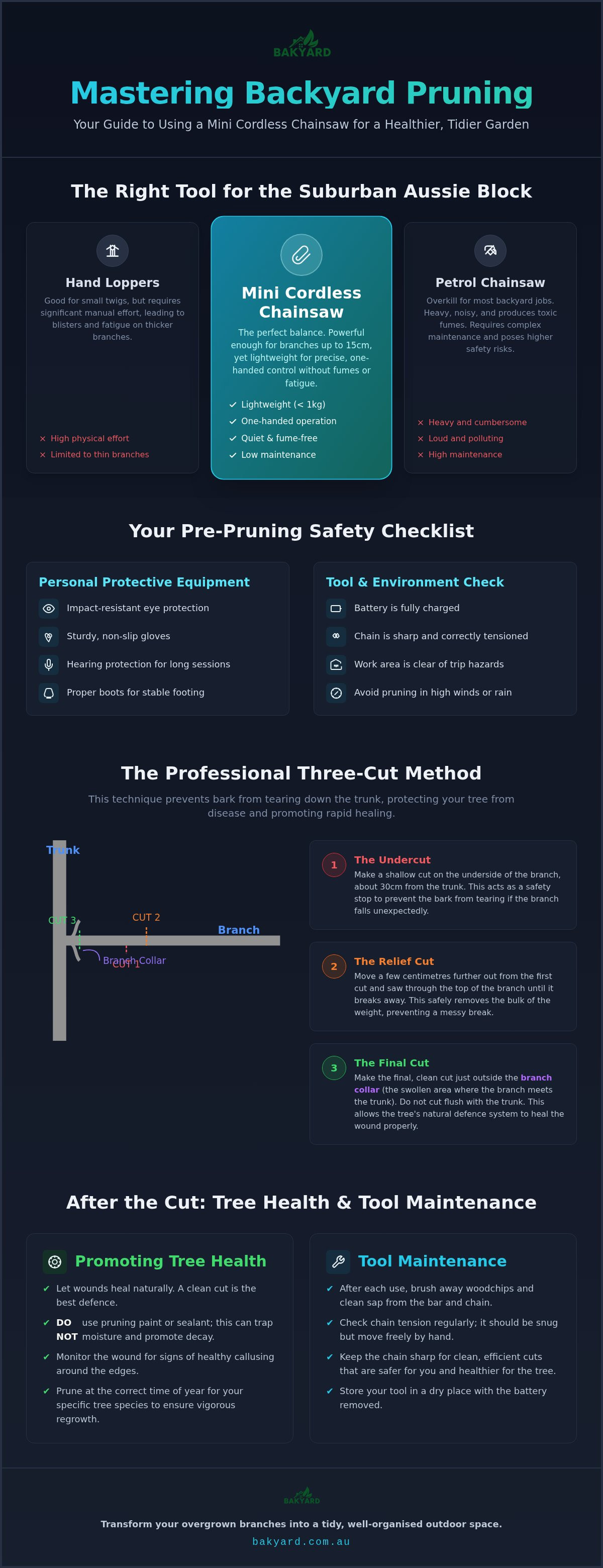
- Step 1: The Undercut. About 15cm away from the trunk, make a small cut on the underside of the branch. Only go about a third of the way through. This acts as a "stop" so that if the bark peels, it stops right at this notch.
- Step 2: The Removal Cut. Move your saw about 5cm further out from your undercut. Cut from the top all the way through. The branch will drop away cleanly, leaving a small stub.
- Step 3: The Finishing Cut. Now that the heavy weight is gone, you can make a precise final cut just outside the branch collar. This clean finish allows the tree to seal itself effectively.
Handling the Tool with Precision
The Bakyard Mini Cordless Chainsaw is designed for ease, but you should still let the tool do the work. Don't push or force the bar into the wood; the high-speed chain is designed to pull itself through. If you feel you have to lean into the cut, your chain might be blunt or the branch might be too thick for the saw.
While these tools are perfect for one-handed operation, using a second hand on the stabilising grip provides extra control for tricky angles. Always be mindful of the "kickback zone"-the upper quadrant of the bar's tip. If this area strikes a hard knot or another branch, the saw can jerk upwards. Maintain good trigger discipline by only engaging the motor once the saw is in position and you are ready to cut. This prevents accidental damage to the healthy branches you want to keep.
After the Cut: Tree Health and Tool Maintenance
The job isn't quite finished when the branch hits the deck. Once you've mastered how to prune trees with a mini chainsaw, you need to look after both the patient and the instrument. Proper post-pruning care ensures your trees recover quickly while maintaining your tool keeps it ready for the next weekend project. A well-maintained saw is safer, more efficient, and far more enjoyable to use.
A common question for Aussie gardeners is whether to use pruning paint or sealants. The 2026 consensus among arborists is that trees are remarkably good at healing themselves. Applying paint can actually trap moisture against the wood, which encourages rot rather than preventing it. Instead, focus on ensuring your cuts are clean and smooth. A ragged cut is far more likely to develop a fungal infection than a clean one made with a sharp chain. Trees seal their own wounds through a natural process, and your goal is simply to leave them in the best position to do so.
Your tool also needs some love after a session in the yard. Sap from native trees like Eucalypts can be incredibly sticky and corrosive if left to dry on the bar. Use a stiff brush or a damp cloth to remove sawdust and sap immediately after use. You should also check your chain tension. A simple "snap" test is all you need: pull the chain away from the bar; it should snap back into place without sagging. When it's time to pack away, check your battery. Lithium-ion cells prefer to be stored with a partial charge rather than being left completely flat. Storing them at around 60% capacity will significantly extend their overall lifespan.
Maintaining Your Tool for Longevity
Even though mini saws are compact, they still require regular lubrication. Check the oil levels before every use to ensure the chain glides smoothly over the guide bar. For enthusiasts wanting to learn more about the science of friction reduction, Motorbull explores advanced molecular metal protection and conditioning. If you notice the saw producing fine, powdery dust instead of thick wood chips, your chain is blunt. Sharpening it only takes a few minutes but makes a world of difference to the tool's performance. Don't forget to clear out the small oil holes in the guide bar. These often get clogged with fine debris, which prevents lubrication from reaching the moving parts.
Keep a close eye on the prune site over the following weeks. Look for any signs of oozing sap, discolouration, or unusual pest activity. These can be early indicators of a fungal issue. Once the work is done, you'll have a pile of cuttings to manage. If you have a home chipper, turn them into mulch to help retain moisture in your garden beds. Otherwise, ensure they are disposed of in your local council green waste bin rather than being left in a heap, which can attract termites near your home.
Keep your garden in peak condition with the easy-to-maintain Bakyard Mini Cordless Chainsaw.
Transform Your Backyard with the Bakyard Mini Cordless Chainsaw
Aussie backyards are our sanctuaries. Whether you're prepping for a summer barbie or just keeping the gum trees in check, having the right gear makes all the difference. Now that you know how to prune trees with a mini chainsaw, you need a tool that matches your new-found skills. The Bakyard Australia Mini Cordless Chainsaw is designed specifically for the unique needs of Australian suburban blocks. It's powerful enough to handle thick limbs but quiet enough to keep the peace with your neighbours. You can finally say goodbye to the frustration of heavy petrol tools and hello to a relaxing, productive afternoon in the sun.
The Bakyard Australia Advantage
One of the biggest hurdles to garden maintenance is the sheer weight of traditional equipment. At just 0.85kg, our mini saw is light enough for anyone in the family to handle comfortably. You won't be fighting with a heavy motor or worrying about messy petrol mixtures. It's about giving you the confidence to work safely and effectively. The cordless system means you can reach the furthest corner of your block without being tethered to a power point or tripping over extension leads.
- Lightweight Design: At just 0.85kg, it's easy for anyone to use without shoulder strain or fatigue.
- High-Torque Motor: Effortlessly cuts through branches up to 15cm thick with a smooth, clean finish.
- Safety First: Features a safety lock-out and ergonomic grip for total control during every cut.
- Free National Shipping: Delivered straight to your door without the fuss of extra freight costs.
When you choose Bakyard Australia, you're getting more than just a tool. You're getting the peace of mind that comes with a one-year Australian warranty and dedicated local support. Our high-torque motor provides consistent power, making it the ultimate solution for a quiet, emission-free garden that respects both the environment and your local community.
Ready to Organise Your Garden?
There is a special kind of satisfaction in looking out over a tidy, well-organised garden. Pruning doesn't have to be a daunting chore that you put off until the next season. With the right technique and a reliable cordless saw, you can keep your trees healthy and your backyard looking its absolute best year-round. It's time to take the first step toward mastering your outdoor space and creating an unforgettable environment for your family.
Mastering how to prune trees with a mini chainsaw is the key to a safer and more beautiful home. You'll have the confidence to tackle those overgrown branches yourself, knowing you have a tool that's up to the task. Don't let a heavy petrol saw or blunt hand loppers hold you back from the garden of your dreams. Grab your gear and transform your outdoor living space today.
Check out the Bakyard Australia Mini Cordless Chainsaw here.
Ready to Master Your Garden?
You now have the knowledge to transform your backyard from a wild thicket into a professional-looking sanctuary. By mastering how to prune trees with a mini chainsaw, you've learned to protect your plants with the three-cut method while keeping yourself safe with the right gear. Remember to always identify the branch collar before you start and keep your chain sharp to ensure every cut is clean and healthy. These small steps make a massive difference in how your trees recover and thrive throughout the Australian seasons.
It's time to put these skills into practice and enjoy the relaxation of a perfectly maintained outdoor space. Join thousands of happy Aussie gardeners who have already simplified their yard work. Upgrade your garden toolkit with the Bakyard Mini Cordless Chainsaw today and enjoy free shipping Australia-wide and the security of a one-year Australian warranty.
Your dream backyard is just a few precise cuts away. You've got this, and we can't wait to see your garden flourish. Happy pruning!
Frequently Asked Questions
Is it safe to use a mini chainsaw with one hand?
Yes, using the Bakyard Mini Cordless Chainsaw with one hand is safe because it weighs only 0.85kg. It's designed for exactly this kind of ergonomic ease. When learning how to prune trees with a mini chainsaw, you'll find this one-handed control allows you to steady branches as you work. It's a much safer, more controlled experience than wrestling with a heavy, vibrating petrol-powered alternative. You should still maintain a stable stance at all times.
How thick can a mini cordless chainsaw actually cut?
A high-quality mini cordless chainsaw can typically cut through branches up to 15cm in diameter. This capacity makes it the perfect tool for almost all standard backyard pruning tasks, from thinning out native shrubs to shaping fruit trees. If you encounter a limb thicker than this, it's best to use a larger tool to avoid straining the motor. Sticking to this 15cm limit ensures your saw remains efficient and your cuts stay clean.
Do I need to use oil with a mini chainsaw?
Yes, you definitely need to use a small amount of bar and chain oil to keep your tool running smoothly. Even though these saws are compact, the chain still creates friction as it moves at high speed. A few drops of oil before you start will prevent overheating and reduce wear on the guide bar. This simple maintenance step ensures your saw cuts through timber like butter and prevents the chain from binding or snapping.
Can I use a mini chainsaw to cut down a whole tree?
No, you should never attempt to fell a whole tree with a mini chainsaw. These tools are specifically engineered for pruning, limbing, and light garden maintenance. Trying to cut down a large tree is dangerous because the small bar can easily get pinched, leading to unpredictable movement or tool damage. For any job involving a full tree removal, it's much safer to hire a professional arborist who has the heavy-duty equipment required for the task.
How often should I sharpen the chain on my mini saw?
You should sharpen your chain as soon as you notice the saw isn't pulling itself into the wood easily. If you see fine dust instead of distinct wood chips, it's a clear sign the teeth are dull. For most Aussie backyard projects, a quick touch-up every few hours of use is ideal. Learning how to prune trees with a mini chainsaw is much easier when the tool is sharp, as it requires less physical effort and creates cleaner cuts.
What happens if the chain comes off during pruning?
If the chain slips, stop the motor immediately and remove the battery before you touch the bar. Chains usually slip because the tension has become too loose during a long pruning session. Simply loosen the side cover, adjust the tension screw until the chain is snug but can still be moved by hand, and then tighten it back up. Regularly checking the tension every ten minutes will prevent this from happening while you work in the garden.
Are mini chainsaws legal to use in residential backyards in Australia?
Yes, mini chainsaws are legal for residential use across Australia, but you must still follow local council regulations. While the tool itself is fine to use, many areas have strict "Tree Protection Orders" that prevent the pruning of certain native species or trees over a specific size. Always check your local council website before starting any major work. Failing to follow these rules can lead to significant fines, even if you are working on your own property.
How do I store the battery during the winter months?
Storing your battery correctly during winter is the best way to ensure it lasts for years. Don't leave it in a cold garden shed; instead, keep it in a dry, room-temperature cupboard indoors. You should also ensure the battery has about 60% charge before putting it away for the season. Lithium-ion cells can degrade if they are left completely flat or fully charged for long periods, so a partial charge is the perfect middle ground for longevity.